


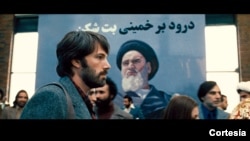
A high-profile French lawyer says Iran will soon take legal action in Europe and the United States against the Academy Award-winning movie Argo, for what Iran alleges is deliberately falsifying history and misrepresenting Iran.
Is it a Hollywood blockbuster only loosely based on fact …or a smear campaign against Iran? French lawyer Isabelle Coutant-Peyre says the Islamic republic believes the American movie Argo deliberately aims to blind its audiences through a twisted portrayal of Iran and Iranians.
In a telephone interview, Coutant-Peyre says the Iranian culture minister asked her to engage in what she calls "useful legal procedures" against the film's distributors and makers. She says that could happen in a matter of weeks, both in Europe and the United States.
Coutant-Peyre says Argo depicts Iranians as crazy, violent and hysterical, which does not at all correspond to the country's ancient culture and civilization. She says it is a Hollywood production with "good guys and bad guys" - very much, she says, like U.S. foreign policy.
Representatives of Warner Brothers, which distributed the film, have said they will have no comment on any Iranian legal moves. The studio did not return calls from VOA.
Argo is based on the 1979 American Embassy hostage crisis in Iran. That was more than 30 years ago. Today, Iran and the international community are at loggerheads over Tehran's nuclear program. Iran claims it is for peaceful purposes, but Western nations fear the country is trying to build a nuclear bomb.
Coutant-Peyre says France would be a good place to file suit against Argo's local distributor, because France once sheltered Iranian revolutionary leader Ayatollah Khomeini.
She says Iran also wants to start legal proceedings against the movie's producer and director in the United States. She says Argo is one of several Hollywood productions that have what she calls a strategy of aggression against Iran.
Coutant-Peyre has a reputation for taking on controversial clients. She defended and also married Venezuelan terrorist Ilich Ramirez Sanchez, better known as Carlos the Jackal. He is serving a life sentence in France for deadly attacks in the 1980s.
Iran is hardly the first to question Argo's accuracy. Both former U.S. president Jimmy Carter and ex-Canadian ambassador Ken Taylor say elements of the film stray far from historical accuracy. And New Zealand's parliament has expressed dismay at its portrayal of Kiwis in Tehran as refusing to help the American hostages.
Argo's makers have previously acknowledged they took liberties with history.
Coutant-Peyre suggests that Iran knows it has little chance of winning a case against the movie. What is important, she says, is to launch a debate about the film, and to show the real face of Iran.