News / Middle East

Iran Nuclear Talks End With Little Progress

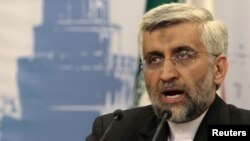
Iran's chief negotiator in nuclear talks, Saeed Jalili, addresses the media in Moscow June 19, 2012.Iran's chief negotiator in nuclear talks, Saeed Jalili, addresses the media in Moscow June 19, 2012.
x
Iran's chief negotiator in nuclear talks, Saeed Jalili, addresses the media in Moscow June 19, 2012.
TEXT SIZE - +
MOSCOW - World powers believe that Iran is enriching uranium to make a nuclear bomb. To avoid a military confrontation, economic sanctions and diplomatic talks are the tools of the moment. But the latest talks with Iran produced little progress.
 
Two days of tough talks over Iran's nuclear program ended Tuesday in Moscow without a date set for a new round.
 
Negotiations between world powers and Iran have been held monthly since April in hopes of keeping Iran from building a nuclear bomb.
 
This time even heavy pressure by Russia, the host nation, failed to get the Iranians to agree to stop enriching uranium.
 
In two weeks, a nuclear experts meeting will be held in Istanbul, according to Catherine Ashton, the lead negotiator for Germany and the five permanent members of the United Nations Security Council, the United States, Britain, France, China, and Russia.
 
"We set out our respective positions in what were detailed, tough and frank exchanges. After five plenary sessions and several bilateral meeting we have begun to tackle critical issues. However, it remains clear that there are significant gaps between the substance of the two positions," she said. 
 
Iranian's chief negotiator, Saeed Jalili, said he hoped a date would be set for another political meeting. But he clung to Tehran's position that Iran has the right to enrich uranium. He said that Iran needs highly enriched uranium for medical and energy needs, not for making a bomb.
 
But the world powers also stuck to their basic demands.  They want Tehran to stop enriching uranium to levels that approach weapons grade. They want Iran to ship out of the country all highly enriched uranium. They want Iran to close an underground enrichment facility, Fordow, and to allow inspections by  United Nations nuclear monitors.
 
The technical meeting will be July 3, two days after European Union sanctions against Iran come into effect. These sanctions, combined with existing U.S. sanctions, are expected to reduce Iran's oil exports to a fraction of last year's levels.
 
After the talks ended here, a senior American officials briefed reporters.  The official said of the Iran talks: "We are not going to get trapped in a process that we do not think is a productive one.
The sanctions will be increasing. We have told the Iranians there will be more pressure coming."
 
The American official and Ashton, the lead European Union negotiator, stressed in press briefings that the world powers are united in opposition to Iran acquiring a bomb.
 
On Monday, U.S. President Barrack Obama and Russian President Vladimir Putin met in Mexico and issued a joint statement on the issue: "We agree that Iran must undertake serious efforts aimed at restoring international confidence in the exclusively peaceful nature of its nuclear program."
 
Ashton said, "The choice is Iran's. We expect Iran to decide whether it is willing to make diplomacy work."
 
Oil sales account for 90 percent of Iran's export revenue. Now, some analysts believe, Iran's leadership may in a race to enrich uranium enough for a bomb - before the economy collapses.
 

James Brooke

A foreign correspondent who has reported from five continents, Brooke, known universally as Jim, is the Voice of America bureau chief for Russia and former Soviet Union countries. From his base in Moscow, Jim roams Russia and Russia’s southern neighbors.

You May Like

India, China Pledge to Overcome Border Tensions

Indian prime minister and Chinese premier attempt to move past tense standoff in the Himalayas during Delhi talks More

Burmese President Opens US Visit with VOA Town Hall Meeting

Ahead of his meeting with President Obama Monday, Thein Sein answered questions on human rights and economic development in his country More

Video Washington Week: Focus on Burma, US Government Scandals

President Thein Sein visits the White House on Monday, Congressional probes of multiple scandals are continuing More

This forum has been closed.
Comment Sorting
Comments
     
by: Saeid from: Iran
June 21, 2012 1:33 AM
we, as Irainian ordinary people only interest in peace and a normal life. Iran government has money, power, army to keep everybody quiet. With its 10% followers unfortuantely they looks they represent all Iranians. I don't have any problem with Israel or US personally. I do beleive that we have much common interests in the subject of Terrorism in Afganistan, Iraq, ... with Israel and US. We don't nuclear power plant when we need good economy for our people.


by: JohnWV from: USA
June 20, 2012 12:41 PM
Iran is only Israel's current fixation. America's entire electoral system has been corrupted by Netanyahu's Israel, AIPAC, Israel Firsters and ingenious distribution of enormous amounts of Jewish money. Our representative democracy is nearly defeated and the destruction of America as we know it well underway. Termination of the criminal treachery and treason demands immediate priority. The Government of the United States must again serve American interests, not the Jewish state's relentless pursuit of invulnerability, territorial conquest and apartheid supremacist empire in, and beyond, the Mideast.


by: Michael from: USA
June 20, 2012 10:03 AM
One would have to consult a juricouncil or mufti to sort out the details, but it seems Iran could look to Central Asia and the largest Islamic association in the world there to obtain energy independence, if all the details would in fact line up with the conduct outlined in the Koran, which is very 'iffy'


by: Robert Rhodes from: Baton Rouge
June 20, 2012 3:28 AM
Iran does have a history of putting extremist Republicans and Christians in the White House to rot the US from within.

Featured Videos

Your JavaScript is turned off or you have an old version of Adobe's Flash Player. Get the latest Flash player.
Video

Video Boston Bomber Spent 6 Months in Russia’s Most Violent Republic

The news of the Boston Marathon bombings circled the globe, and resonated here in Dagestan, a majority Muslim republic in Russia, on the shores of the Caspian Sea. Last year, Tamerlan Tsarnaev, the older of two brothers suspected of the bombings and a long-time Boston resident, returned to Dagestan, where he had lived for a year during his youth. Dagestan was the land of his maternal ancestors. But in the last two years, this republic of 3 million people has gained notoriety as the region with the highest level of political and religious violence in all of Russia. VOA's James Brooke reports from Makhachkala, Russia.