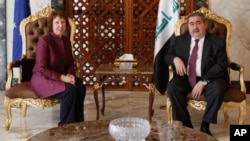
Iraq's Foreign Minister Hoshyar Zebari, right, meets with EU foreign policy chief Catherine Ashton upon her arrival at Baghdad International Airport in Iraq, May 23, 2012.
Six world powers holding nuclear talks with Iran in Baghdad agreed Thursday to hold another round of negotiations in Moscow next month to try to resolve international concerns about the Iranian nuclear program.
After wrapping up two days of talks in the Iraqi capital, EU foreign policy chief Catherine Ashton said the two sides found "some common ground" but also had "significant differences." She told reporters Iran and the six-nation group agreed to more talks in the Russian capital on June 18 and 19 to "expand that common ground."
Related video from VOA's Brian Padden
Ashton represented the world powers in the Baghdad talks with Iran's chief negotiator Saeed Jalili, whom she met earlier Thursday. She described the talks as "very intense" and said Iran declared a "readiness" to address international concerns about its enrichment of uranium to 20 percent purity.
Western powers want that activity to stop, fearing Iran could quickly upgrade its uranium to the 90 percent purity needed for nuclear weapons. Iran wants an easing of international sanctions in return for any concession on enrichment work, which it says is meant for medical research and generating electricity.
Speaking after the Baghdad talks, Jalili emphasized what he called "the absolute right" of Iran to enrich uranium for peaceful purposes. He also said the nuclear dispute can be solved only through dialogue. Jalili said experts of the two sides will be in contact to prepare for the Moscow meeting.
The world powers include the five permanent members of the U.N. Security Council plus Germany.
In Washington, U.S. Secretary of State Hillary Clinton said there would be no let up in sanctions against Iran, even as talks continue. She said significant differences remain between the two sides and that it is now up to Iran "to close the gaps."
The overall message, however, was to keep talking.
Earlier, EU spokesman Michael Mann told VOA that the six nations presented a "clear" proposal calling on Iran to address international concerns about its nuclear program in return for "reciprocal measures" that the group believes will be attractive to Tehran. He said it is important for Iran to engage in the negotiations "seriously."
Iran's delegation in Baghdad offered its own proposal for ending the dispute. Iranian state media said Thursday that offer is more comprehensive than that of the world powers and accused the United States of being unwilling to express a position on it.
Diplomats said the world powers offered Iran incentives to stop production of highly enriched uranium and transfer the material abroad in exchange for nuclear fuel for its research reactor in Tehran. Iranian diplomats expressed disappointment with that offer, complaining that it makes too many demands of Iran without enough benefit.
In an interview with VOA, Middle East analyst Shahram Akbarzadeh said Iran may make a few concessions in a bid to ease economic sanctions.
"If by giving in to the international community slightly, if by taking one step back allows the sanctions to be cancelled, then Iran would do that," said Akbarzadeh. "But I don't think you can expect Iran to be fully cooperative with the international community."