



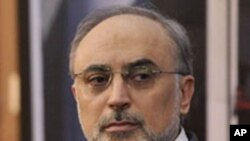
Iranian state media say President Mahmoud Ahmadinejad has fired Foreign Minister Manouchehr Mottaqi. His interim replacement is Ali Akbar Salehi, the head of Iran's atomic energy agency and the driving force behind the nuclear program that has put Iran at odds with much of the world.
Iranian Foreign Minister Manouchehr Mottaqi was fired just a week after Iran had agreed in talks with world powers to hold more negotiations on its disputed nuclear program.
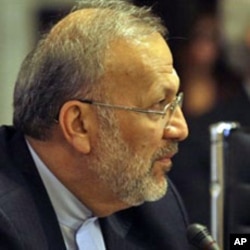
President Ahmadinejad offered his appreciation for Mottaqi's work, but offered no explanation for the surprise move.
His interim replacement, Ali Akbar Salehi, is believed to be closer personally to the president and, as was Mottaqi, a staunch defender of Iran's right to pursue nuclear energy.
The Iranian government insists its atomic program is only for civilian use, but the nation has been repeatedly sanctioned by the United Nations for not revealing information that could prove there is no military component to its work.
Just days before the international talks earlier this month, Salehi announced Iran is capable of producing yellow-cake uranium, an important step in the process of enriching the material.
Salehi described the development as part of Iran's ongoing efforts to mine uranium domestically, and offered his thanks to Mr. Ahmadinejad for the push the president has given the program.
It was widely seen as a counterpoint to the idea that international sanctions and a mysterious computer worm that had infected many Iranian nuclear computer systems had slowed the nation's efforts.
Iranian reformist websites speculated Mottaqi was ousted for being too moderate on the nuclear issue. But Iranian History Professor Ali Ansari, of St. Andrews University in Scotland, says the switch would have little immediate effect on the international front.
"I do not think there will be any significant change on the nuclear issue for the simple reason that not a huge amount is going on," said Ansari. "I think that what this shows is actually more the disputes within the system rather than policy without, so to speak. I think it reflects more a division of opinion and personality clashes within the system."
The inner workings of the Iranian government are far from transparent, leading to the modern day equivalent of Soviet-era "Kremlin-watching" - a way to understand who is in favor and who is not. Much analysis has centered on supposed tensions between President Ahmadinejad and Iran's Supreme Leader Ayatollah Ali Khamenei.
"Ahmedinejad wanted to have greater control of foreign policy making and he was quite keen to appoint his own special envoys on foreign policy," said Professor Ansari. "And this was a clash basically with Mottaqi on this basis. Mottaqi felt that foreign policy should be his responsibility. And I think he may have had a closer relationship perhaps with the supreme leader and felt the supreme leader would back him on this."
The interim foreign minister, in addition to being close to Mr. Ahmadinejad, has served as a nuclear advisor to the Iranian government and was named head of the Atomic Energy Organization last year. He received a doctoral degree from America's prestigious Massachusetts Institute of Technology in the 1970's, prior to the Islamic revolution.
The outgoing Mottaqi, a career diplomat and foreign minister since 2005, is currently visiting Senegal.