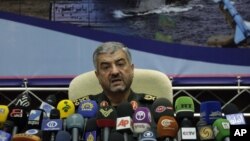
Iran says advisers from its elite Islamic Revolutionary Guards Corps are providing non-military assistance in Syria - and that Tehran may take military action if its closest ally is attacked by outside forces.
The statement by guards' commander Mohammad Ali Jafari on Sunday is the first official acknowledgement that Iran has a military presence in Syria, where warfare during a government crackdown on an 18-month-old opposition uprising has left thousands dead.
Iranian media quoted Jafari as saying that a number of "Quds Force" members "are present in Syria." He did not indicate how many but said they are providing "intellectual and advisory help."
The Quds Force is a Revolutionary Guards' unit set up to export Iran's ideology. It has been accused of plotting attacks inside Iraq since the ouster of the late dictator Saddam Hussein.
U.S. officials this month said Iraq was facilitating the transfer of weapons to Syria by opening its airspace to Iranian aircraft. Baghdad has denied the accusation.
Jafari also said any Israeli attack on Iran would trigger retaliatory action against U.S. bases in the region and that trade through the Strait of Hormuz would be disrupted.
Meanwhile, violence continued in Syria as government troops pounded rebel-held districts Sunday in the cities of Damascus, Aleppo, Daraa, Hama, Homs and Deir Ezzor with aerial bombardments and heavy artillery.
The Britain-based Syrian Observatory for Human Rights said at least 20 people were killed in the fighting.
Also Sunday, international peace envoy Lakhdar Brahimi left Damascus after a four-day visit during which he met with Syria's President Bashar al-Assad.
The rebel commander for northern Aleppo province told the French news agency that Brahimi's mission would likely not succeed but that anti-government forces "do not want to be the reason for his failure."
Colonel Abdel Jabbar al-Okaidi told AFP he had participated in a conference call with Brahimi and two other rebel commanders.
Okaidi said the U.N.-Arab League envoy's mission will fail because "the international community does not actually want to help the Syrian people."
Eighteen months into the crisis, international action remains paralyzed, with the West, the Gulf Arab states and Turkey calling for Mr. Assad's removal, and Russia and China standing by their ally in Damascus.
The statement by guards' commander Mohammad Ali Jafari on Sunday is the first official acknowledgement that Iran has a military presence in Syria, where warfare during a government crackdown on an 18-month-old opposition uprising has left thousands dead.
Iranian media quoted Jafari as saying that a number of "Quds Force" members "are present in Syria." He did not indicate how many but said they are providing "intellectual and advisory help."
The Quds Force is a Revolutionary Guards' unit set up to export Iran's ideology. It has been accused of plotting attacks inside Iraq since the ouster of the late dictator Saddam Hussein.
U.S. officials this month said Iraq was facilitating the transfer of weapons to Syria by opening its airspace to Iranian aircraft. Baghdad has denied the accusation.
Jafari also said any Israeli attack on Iran would trigger retaliatory action against U.S. bases in the region and that trade through the Strait of Hormuz would be disrupted.
Meanwhile, violence continued in Syria as government troops pounded rebel-held districts Sunday in the cities of Damascus, Aleppo, Daraa, Hama, Homs and Deir Ezzor with aerial bombardments and heavy artillery.
The Britain-based Syrian Observatory for Human Rights said at least 20 people were killed in the fighting.
Also Sunday, international peace envoy Lakhdar Brahimi left Damascus after a four-day visit during which he met with Syria's President Bashar al-Assad.
The rebel commander for northern Aleppo province told the French news agency that Brahimi's mission would likely not succeed but that anti-government forces "do not want to be the reason for his failure."
Colonel Abdel Jabbar al-Okaidi told AFP he had participated in a conference call with Brahimi and two other rebel commanders.
Okaidi said the U.N.-Arab League envoy's mission will fail because "the international community does not actually want to help the Syrian people."
Eighteen months into the crisis, international action remains paralyzed, with the West, the Gulf Arab states and Turkey calling for Mr. Assad's removal, and Russia and China standing by their ally in Damascus.