



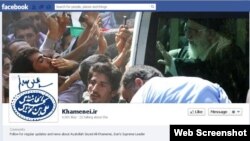
Not to be outdone by the Pope’s creation of a Twitter account, Iran’s Supreme Leader, Ayatollah Ali Khamenei has joined Facebook, a site off limits to most Iranians due to internet filters imposed by the state.
The public page was launched Friday, and already has over 5,000 likes. It is run by Khamenei’s staff and so far has posted four photos of Iran’s most powerful man.
The profile picture is his official seal with his handwritten signature and full name in Persian script “Seyed Ali Khamenei,” and the cover photo shows him riding in a car among his followers.
There are also links to his speeches as well as a picture of a young Khamenei alongside the founder of the Islamic Republic, Ayatollah Ruhollah Khomeini, in the 1960s.
The few posts have received a lot of feedback, with hundreds of likes and comments ranging from messages of love to extreme criticism and even wishes for his death.
Unlike the Pope, who just joined Twitter earlier in December, Khamenei has been using the short messaging site since March of 2009.
The office of Iran's Supreme Leader also runs a website www.khamenei.ir, an outlet that publishes news and information in 13 languages, and an Instagram site.
Iranian watchers were not surprised by Khamenei’s move to Facebook.
“Ayatollah Khamenei and his cohorts have a clear-cut record in using social media tools to spread their message when it suits them,” says Alex Vatanka, a scholar at the Washington-based Middle East Institute. “There are hundreds of pro-regime websites paid for by the regime. But the playing field is far from level. Inside Iran, the regime is in the enviable position where it can block anyone they don’t like from competing with them in cyberspace. They are not asking for an open contest of ideas, because I am sure the regime thinks – rightly in my view – they will lose that battle."
Khamenei’s Twitter account has occasionally been used to publish controversial statements. An example was in August, when it published a statement condemning the 2011 takeover of the British Embassy in Tehran.
The tweet read: “Leader of the revolution in a meeting with students: in the recent takeover of that evil embassy [England], the youth were right in their emotions but their behavior was not right.”
That was the first time Ayatollah Khamenei publicly condemned the highly publicized attack, which was attributed to students and resulted in Britain cutting ties with Iran.
While both Twitter and Facebook are blocked by Iran’s Internet censors, they are still widely used by Iranians with the technical know how to get around the bans.
During the 2009 post-election protests known as the 'Green Movement' in Iran, social media outlets such as Facebook and YouTube served as powerful tools for protesters. It allowed them to publish images and videos and convey what was happening in Iran.
Despite Khamenei’s move onto a banned website, Iran has long claimed it is developing its own national intranet, Halal internet, which officials say will be free of un-Islamic content and will be easier to monitor. Iran recently launched its own version of Youtube called MehrTube.
The public page was launched Friday, and already has over 5,000 likes. It is run by Khamenei’s staff and so far has posted four photos of Iran’s most powerful man.
The profile picture is his official seal with his handwritten signature and full name in Persian script “Seyed Ali Khamenei,” and the cover photo shows him riding in a car among his followers.
There are also links to his speeches as well as a picture of a young Khamenei alongside the founder of the Islamic Republic, Ayatollah Ruhollah Khomeini, in the 1960s.
The few posts have received a lot of feedback, with hundreds of likes and comments ranging from messages of love to extreme criticism and even wishes for his death.
Unlike the Pope, who just joined Twitter earlier in December, Khamenei has been using the short messaging site since March of 2009.
The office of Iran's Supreme Leader also runs a website www.khamenei.ir, an outlet that publishes news and information in 13 languages, and an Instagram site.
Iranian watchers were not surprised by Khamenei’s move to Facebook.
“Ayatollah Khamenei and his cohorts have a clear-cut record in using social media tools to spread their message when it suits them,” says Alex Vatanka, a scholar at the Washington-based Middle East Institute. “There are hundreds of pro-regime websites paid for by the regime. But the playing field is far from level. Inside Iran, the regime is in the enviable position where it can block anyone they don’t like from competing with them in cyberspace. They are not asking for an open contest of ideas, because I am sure the regime thinks – rightly in my view – they will lose that battle."
Khamenei’s Twitter account has occasionally been used to publish controversial statements. An example was in August, when it published a statement condemning the 2011 takeover of the British Embassy in Tehran.
The tweet read: “Leader of the revolution in a meeting with students: in the recent takeover of that evil embassy [England], the youth were right in their emotions but their behavior was not right.”
رهبر انقلاب در دیدار دانشجویان: در قضيه اخير اشغال آن سفارت خبيث [انگلیس]، احساسات جوانان درست بود ولي رفتنشان درست نبود
— khamenei.ir (@khamenei_ir) August 6, 2012
That was the first time Ayatollah Khamenei publicly condemned the highly publicized attack, which was attributed to students and resulted in Britain cutting ties with Iran.
While both Twitter and Facebook are blocked by Iran’s Internet censors, they are still widely used by Iranians with the technical know how to get around the bans.
During the 2009 post-election protests known as the 'Green Movement' in Iran, social media outlets such as Facebook and YouTube served as powerful tools for protesters. It allowed them to publish images and videos and convey what was happening in Iran.
Despite Khamenei’s move onto a banned website, Iran has long claimed it is developing its own national intranet, Halal internet, which officials say will be free of un-Islamic content and will be easier to monitor. Iran recently launched its own version of Youtube called MehrTube.