


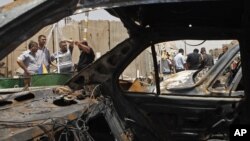
An examination of Iraq’s deadliest single day of attacks in more than two years has revealed a series of clues about the identity of the perpetrators and their motives. Analysts say the wave of bombings and shootings is the latest in a series of mass casualty incidents that illustrate the strengths and weaknesses of al-Qaida-linked militants and Iraqi security forces.
Monday’s attacks happened during a period of several hours in more than 15 towns and cities across the country, killing at least 110 people.
Toby Iles, a Middle East editor at the Economist Intelligence Unit in London, said the casualties included a relatively large proportion of Iraqi security personnel, and many of the attacks targeted predominantly Shi’ite areas, such as the Sadr City and Hussainiya districts of Baghdad. “Hitting both of those targets would fit with [the perpetrators] being al-Qaida in Iraq,” Iles said.
Al-Qaida is a Sunni extremist militant group that has repeatedly tried to provoke majority Shi’ites who lead the Iraqi government into a sectarian war with minority Sunnis.
Ranj Alaaldin, a senior analyst at the London-based Next Century Foundation, said attacks such as those of July 23 require planning, resources and experience.
“Al-Qaeda in Iraq would therefore be the obvious and primary suspect, given the organization’s unparalleled record in Iraq,” he said. “But given the loosely organized structure of AQI, it could very well be some elusive offshoot group.”
Anthony Cordesman, an Iraq expert at Washington’s Center for Strategic and International Studies, said Sunni jihadist groups tied to al-Qaida have a variety of motives for carrying out large-scale operations.
“Part of these (goals) are to attack and kill Iraqi officials, part of them are to create high visibility attacks which get a lot of coverage and convince people that the government cannot provide security, and [another objective is to] bring back the kind of ethnic and sectarian fighting that took place earlier in the mid-2000s and was essentially a civil war,” he said.
An Iraqi Kurdish newspaper editor in the northern Iraqi city of Kirkuk said it is notable that the attacks coincided with talks by major Iraqi government factions aiming to resolve long-running disputes.
Haji Kirkuki said the militants behind the violence were trying to disrupt the negotiations involving the Sunni-backed Iraqiya Alliance of Ayad Allawi and Prime Minister Nouri al-Maliki's Shi'ite National Alliance.
Al-Qaida’s Iraqi wing, which calls itself the Islamic State of Iraq, has claimed responsibility for a series of high-profile attacks in recent years. In a statement posted on a militant website Saturday, the group warned of a new offensive to return to strongholds from which it was ousted by U.S. and Iraqi forces.
Cordesman, a former U.S. Defense and State Department official, said attacks by Sunni jihadists in Iraq have improved steadily in sophistication and coordination.
“Insurgents, we have to remember, now have something on the order of eight years of experience in finding the areas where the security forces are weak and in finding the areas which produce the biggest political and media impact when they do organize attacks,” he said.
But Cordesman identified several weaknesses in militant capabilities, saying attacks happen only at intervals, take time to organize and rarely hit a critical target. “Very often, they don't produce significant tactical effects.”
Iraq’s average monthly civilian death toll was just above 300 in the first half of this year, a slight decrease from 2011 and 2010. The casualty rate also is significantly lower than at the height of Iraq’s sectarian violence in 2006 and 2007, which saw monthly death tolls exceeding 2,000.
Alaaldin, also an Iraq specialist at the London School of Economics, said al-Qaida in Iraq has “some way to go” before it can repeat the atrocities of 2006 to 2007.
“Back then, al-Qaida had the benefit of a security vacuum and a sectarian war, which provided it with ample room to flourish, which does not exist at the moment,” he said. “Now it lacks the ability to take on a very organized and effective Iraqi army.”
The ISI statement also claimed that most Iraqi Sunnis are waiting for al-Qaida’s return. But EIU expert Iles said the reality is different.
“There's an element of wanting more stability in Iraq among the citizens. And that's one of the key determinants for why the government manages to stick together even despite all its disagreements.”
Cordesman said Iraqi government forces have earned the support of many Shi’ites who no longer see the need for militias as an alternative to a Shi’ite-dominated military.
Alaaldin said the Iraqi government also has won the cooperation of Sunni tribes who prefer to work with the state rather than al-Qaida. “In the past, their affiliation with AQI cost them dearly,” he said.
But Cordesman said Iraqi security forces lack the capability to gather intelligence on impending attacks and suffer from poor coordination between police and counter-terrorism personnel.
Iraq also lacks the unmanned combat aircraft, helicopters and sophisticated intelligence systems for tracking communications that existed before U.S. forces left the country last year.
Cordesman said the Iraqi government’s ongoing political crisis also is a cause for concern.
“Given that efforts to create a national unity government have not only so far failed, but led to more and more power struggles between Prime Minister Maliki and the Sunni factions as well as the Sadrists, it is not clear that insurgents are unable to eventually divide Iraq along sectarian lines,” he said. “But that certainly is not something that has happened yet.”