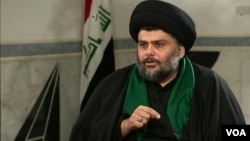
Iraq's prominent radical Shi'ite cleric Moqtada al-Sadr has called for the fair implementation of national security laws that have drawn weeks of protests from minority Sunnis who see them as biased against their community.
In an interview with VOA's sister television network, Alhurra, al-Sadr said he agreed with Sunni protesters that the government of Iraq's Shi'ite prime minister has been acting in a biased way. "We believe the problem is in the implementation of the [security] laws, and not the laws themselves," al-Sadr said.
He said his Shi'ite political movement wants Prime Minister Nouri al-Maliki to fairly apply the laws, which enable the detention of suspected terrorists and the removal of officials linked to the Baath party of Iraq's former Sunni dictator, Saddam Hussein. Al-Sadr's party, the Sadrist Trend, is a member of Maliki's ruling coalition and has 40 seats in the 325-member parliament.
Sunni complaints
Thousands of Iraqi Sunnis have been staging weeks of anti-government protests across the country, denouncing what they see as Maliki's use of the security laws to target and marginalize the Sunni minority. The protests erupted last month in response to security forces detaining the bodyguards of Iraq's Sunni finance minister - one of the few Sunni members of Maliki's Cabinet.
Many Sunni demonstrators also accuse the prime minister of acting like a dictator and want him to resign. In the largest protest, Sunnis have blocked a key highway for three weeks in the western province of Anbar.
In the interview, al-Sadr expressed sympathy for the protests, saying he does not differentiate between fellow Shi'ites and Sunnis. "What is happening in Anbar province is not a crisis, but a healthy phenomenon that reflects a popular and democratic movement," al-Sadr said.
Calls for reform
He also said most Sunni demonstrators want the controversial security laws to be reformed rather than eliminated. "They are only against the way [the laws] are being implemented. They are for de-Baathification [of the government], but without discrimination."
Al-Sadr suggested Maliki should resign over the crisis. "The prime minister should act as a father figure to all Iraqis. If the father does not play a just and fair role between his children, he does not deserve the title of father figure."
But the Shi'ite cleric declined to join the protesters' demand for an amnesty to be granted to Sunni women detained under the anti-terrorism law. When asked about the demand, al-Sadr said he believes the law has been implemented "badly," but he also added that "all of us want to fight terrorism."
Maliki's response
The Iraqi prime minister has said that he will not tolerate mass anti-government protests indefinitely and warned the government has the ability to re-open the blocked Anbar provincial highway. He also has accused Sunni partners in his ruling coalition of stalling legislation and being uncooperative in an effort to undermine him.
Hundreds of Iraqi Shi'ite supporters of Maliki staged a counter-demonstration Saturday in Baghdad, urging him to resist calls for a prisoner amnesty and changes to the security laws.
The anti-government protests have put further strain on Iraq's fragile coalition government as its Shi'ite, Sunni and Kurdish factions prepare to challenge each other and the opposition in provincial elections in April.
Iraq's Sadr Demands 'Fair Implementation' of National Security Laws