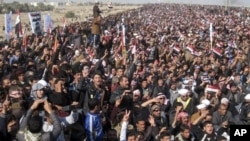
Thousands of Iraqi Sunnis again took to the streets on Friday, demanding an end to what they see as second-class treatment.
At mass demonstrations in Fallujah, Tikrit, Ramadi and Mosul, protesters called on the government of Shi'ite Prime Minister Nouri al-Maliki to release fellow Sunnis being held as prisoners.
Sunni protesters also gathered in Baghdad, where they received a show of support from radical Shi'ite cleric Moqtada al-Sadr, who prayed with Sunnis at the city's Abdul Qadir al-Gailani mosque before visiting Our Lady of Salvation Catholic church, the scene of a deadly 2010 attack blamed on extremists.
"We sympathize with demonstrators and with their demands," said the cleric, who backed Maliki following Iraq's 2010 elections, but has since joined Sunnis and Kurds in calling for his resignation. "Their demands are right and we have only one comment on de-Baathification: we don't want the Baath party to rule again."
Sunni worshipers outside the mosque shouted praise and pro-Iraqi slogans as al-Sadr departed.
The cleric recently warned that Iraq is not immune to influence of Arab Spring events that have brought change to other parts of the region.
Latif Mostafa Amin, a Kurdish member of Iraqi parliament, said Maliki's refusal to alter what he called discriminatory policies could cause Iraq to fall apart. Maliki, who has made some concessions since the protests began, agreeing to free some female prisoners, also warned earlier this week that massive anti-government rallies would not be tolerated indefinitely.
"I say to those who follow these agendas: Don't believe it's difficult for government to take measures against you or to re-open the road and put an end to this matter," he said. "But you have to understand that you have to rush to end this issue, and I'm warning you that continuing this is a breach to the constitution."
At least 20 Shi'ite Muslim pilgrims were killed Thursday on their way home from a religious procession in the country's south.
Police said the attack at a busy bus station in the town of Musayyib hit the pilgrims as they were returning from Iraq's shrine city of Karbala, where they performed mourning rituals for a revered figure in Shi'ite Islam. Dozens were wounded in the bombing.
No one has claimed responsibility for the attack.
The blast comes just days after a wave of bombings across the country killed 23 people. Insurgents blew up several houses in Musayyib on Monday, killing seven people. Bombings also killed people in Baghdad, Hillah and Kirkuk.
At mass demonstrations in Fallujah, Tikrit, Ramadi and Mosul, protesters called on the government of Shi'ite Prime Minister Nouri al-Maliki to release fellow Sunnis being held as prisoners.
Sunni protesters also gathered in Baghdad, where they received a show of support from radical Shi'ite cleric Moqtada al-Sadr, who prayed with Sunnis at the city's Abdul Qadir al-Gailani mosque before visiting Our Lady of Salvation Catholic church, the scene of a deadly 2010 attack blamed on extremists.
"We sympathize with demonstrators and with their demands," said the cleric, who backed Maliki following Iraq's 2010 elections, but has since joined Sunnis and Kurds in calling for his resignation. "Their demands are right and we have only one comment on de-Baathification: we don't want the Baath party to rule again."
Sunni worshipers outside the mosque shouted praise and pro-Iraqi slogans as al-Sadr departed.
The cleric recently warned that Iraq is not immune to influence of Arab Spring events that have brought change to other parts of the region.
Latif Mostafa Amin, a Kurdish member of Iraqi parliament, said Maliki's refusal to alter what he called discriminatory policies could cause Iraq to fall apart. Maliki, who has made some concessions since the protests began, agreeing to free some female prisoners, also warned earlier this week that massive anti-government rallies would not be tolerated indefinitely.
"I say to those who follow these agendas: Don't believe it's difficult for government to take measures against you or to re-open the road and put an end to this matter," he said. "But you have to understand that you have to rush to end this issue, and I'm warning you that continuing this is a breach to the constitution."
At least 20 Shi'ite Muslim pilgrims were killed Thursday on their way home from a religious procession in the country's south.
Police said the attack at a busy bus station in the town of Musayyib hit the pilgrims as they were returning from Iraq's shrine city of Karbala, where they performed mourning rituals for a revered figure in Shi'ite Islam. Dozens were wounded in the bombing.
No one has claimed responsibility for the attack.
The blast comes just days after a wave of bombings across the country killed 23 people. Insurgents blew up several houses in Musayyib on Monday, killing seven people. Bombings also killed people in Baghdad, Hillah and Kirkuk.