



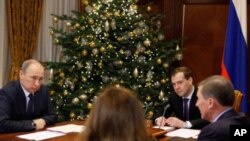
Russian Prime Minister Vladimir Putin switches campaign managers in the middle of an election campaign. Is his position as solid as he would like the world to think?
The prime minister was talking tough, telling a nationwide TV audience that the parliamentary elections are over, and it’s time to move on.
But the tough talk came days after his government announced political reforms in hopes of taking the momentum out of a planned opposition rally. The move seemed to have had little impact. The rally, which took place in Moscow Saturday, drew an estimated 100,000 protesters.
“The psychological compensation he needs when being forced to make some moves and being afraid that these moves in a positive direction being perceived as his weakness,” said Nikolai Petrov, political analyst for the Carnegie Moscow Center, about the tough talk.
A clear sign of problems came Tuesday when Putin decided to switch campaign managers - less than 10 weeks before the presidential election.
Vladislav Surkov, the sidelined political advisor, helped Putin come to power in 2000. A former advertising man, he worked for a decade in the Kremlin. He created the now ruling United Russia party. He created Nashi, the Putin youth group. And he brought television channels under tight political controls.
“This replacement weakens the Kremlin in that Surkov is the founding father of the big political machine which will not work effectively without him,” said Petrov, who worked in the Kremlin before Surkov arrived.
The new political advisor, Vyacheslav Volodin, was a founder of the Russia Popular Front, a support group of trade unions and professional groups.
This heavily blue collar group may become a key pillar of support for Putin as Russia’s urban middle class tire of him. At a televised meeting of the Front on Tuesday, Putin, nodded sympathetically as a retired metal worker spoke of his outrage at the anti-government postings on Russia’s free-wheeling Internet.
Legitimacy

Putin seeks to win the March 4 presidential elections on the first round, with over 50 percent of the vote.
Talking to Front members, he called for transparent election, using clear plastic ballot boxes. He stressed his desire that election be perceived - in Russia and overseas - as legitimate.
He said he can be elected president without ballot stuffing.
On Wednesday, a Wall Street Journal computerized study of returns from Russia’s nearly 100,000 polling stations concluded that about 40 percent of votes cast for the ruling party were in some way associated with ballot stuffing and other fraudulent practices.
Putin warned his supporters that they should not tolerate any “independent actions” at polling stations.
Measures against corruption
The opposition has vowed to send dozens of poll watchers to stations where they suspect there was fraud in the Dec. 4 parliamentary elections.
Indeed, the new drive for free and fair elections shows no sign of going away.
In a survey conducted by the All-Russian Public Opinion Center, 89 percent of those polled said they plan to join more rallies after Russia’s mid-winter break, which starts Friday.
This week in Moscow, protesters rallied outside a court where one protest leader, Sergei Udaltsov, was being tried. Dozens got in shoving matches with police inside a courthouse. Hundreds more rallied outside. They chanted “Shame on the corrupt court,” and that the judge was “A servant of Satan.”
More, small unsanctioned demonstrations planned for this week in Moscow.
Last Friday, Alexei Kudrin, a former finance minister and close friend of Putin, met with Putin and discussed the opposition movement. The next day, Kudrin spoke at the mass, opposition rally. He warned that, without dialogue, there could be revolution.
He was loudly booed.