News / Middle East

    Islamic State Suffering Setbacks in Libya

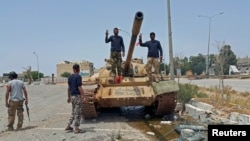
    FILE  - Members of Libyan pro-government forces on a tank in Benghazi, May 21, 2015
    FILE - Members of Libyan pro-government forces on a tank in Benghazi, May 21, 2015

    A few days ago fighters with Islamic State’s affiliate in Libya were gloating about recent battlefield successes and appeared poised to launch an offensive on oil fields near Sirte, the coastal city they overran last month. But in recent days they suffered two serious reversals.

    A US airstrike mounted in the early hours of Sunday morning seems likely to have taken out a significant jihadi ally - veteran jihadist leader Mokhtar Belmokhtar, the instigator of the deadly storming of a natural gas plant in Algeria in 2013 that left 39 hostages dead.

    And in Derna, which Islamists and jihadists have been battling for control of for weeks, local reports - which are difficult to verify - point to Islamic State being pushed out of most of the city, although locals contacted by phone say there is still fighting in the center.

    An Egyptian IS commander is reported to have been killed in Derna. The jihadists, according to Mohamed Eljarh, an analyst for the Rafik Hariri Center of the Atlantic Council “have lost control of most of their sites within the city of Derna.”

    According to Thomas Joscelyn, an analyst at the Foundation for Defense of Democracies, a US think tank, the fighting in Derna is not going the Islamic State’s way. “It is a battle Abu Bakr al Baghdadi’s men risk losing."  He added, “a few of the Islamic State’s key leaders in Derna have been reportedly killed or captured, but the details remain murky.”

    But he warns, “It is too early to declare a victor. There is an ebb and flow to such battles, and the group has struck back by unleashing its signature suicide bombers in the heart of the city.”

    But officials in both of Libya’s rival governments — an internationally recognized one based in Tobruk and Beida, and an Islamist-dominated rebel administration in Tripoli — caution that as long as the country remains ensnared in a civil war, the jihadis will have plenty of opportunities to capitalize on the power struggle dividing the country. And the government in Tobruk/Beida is urging the West to intervene more heavily to take on jihadi groups.

    As jihadis were being pushed out of Derna they launched two suicide bombing attacks.

    The alliance battling Islamic State in Derna is not, though, a moderate or secular-based one: most of the militias involved are considered hardline Islamist and a couple, including the Abu Salim Martyrs Brigade, have been linked to al-Qaida.

    A political activist based outside Libya, Ayat Mneina, posted on her Facebook page that ordinary residents are siding with the anti-IS alliance. “Civilians have joined the fight against terrorism in the city. Just spoke to cousins who are all out fighting, defending their city,” she posted.

    Both governments for propaganda purposes have accused the other at various times of assisting jihadis.

    But the loss of Sirte to the jihadis as well as checkpoint suicide bombings near the town of Misrata recently have unnerved the rival governments and added some impetus to peace talks. The government in Beida issued a statement saying the US had consulted with it before launching the weekend airstrike targeting a farmhouse near the eastern city of Ajdabiya, where Belmokhtar was meeting with jihadis aligned reportedly with different Islamic extremist groups.

    “The Libyan government confirms that this operation is part of the international support which has long been called for by the interim Libyan government to fight terrorism,” read the statement.

    The setbacks recently dealt to the jihadis, though, could be reversed, if the power struggle dividing Libya persists, analysts and Western diplomats warn.

    Last week, UN-sponsored talks in Morocco and Berlin between the rival governments - both are being pushed hard by European governments to resolve their standoff - appeared to be heading for failure, despite the fact that for the first time since the peace initiative was launched the four-strong negotiating teams met face-to-face.

    The Tripoli government, known widely as Libya Dawn, accepted a fourth and final draft of a complicated peace deal drawn up by UN envoy Bernardino Leon. But the recognized government, which fled east last summer, chased out of the Libyan capital by Libya Dawn militias, has so far rejected the deal - as have some in the town of Misrata, a key backer of the government in Tripoli.

    Leon once again on Monday urged the warring factions to reach an agreement, stressing “the need for Libyans to put an end to conflicts and to act quickly to reach a political agreement, restore security and stability in their country.” The envoy has marked June 17 - the day before Ramadan starts - as a deadline for a deal.   Western diplomats have warned both governments that only jihadi groups will be the winners if there isn't an accord.

    Last week, German Foreign Minister Frank-Walter Steinmeier said during the Berlin round of talks that diplomats had warned the rival governments there wouldn’t be many more opportunities to reach a deal. “Perhaps this is the last chance to prevent Libya from complete collapse,” he said.

    While official talks have stalled, some tribal and militia leaders backing opposing sides have tried to hammer out local deals themselves in western Libya. Militias from the towns of Zintan and Zawia oversaw truces agreed between Zuwara and the nearby towns of Al-Jmail, Rigdalin and Zultan.

    That agreement followed a local deal being agreed between Zintan, which backs the government in Beida, and Gharyan. The deals are a result of the intervention of tribal elders.

    You May Like

    Why Syria Election Will Hand Assad Victory

    Outcome is foregone conclusion, say opposition politicians and independent election experts who dub next week’s wartime poll a PR stunt

    Victims of Violence Focus Gun Laws in 2016 Campaign

    In New York City, grieving family members of people killed by guns gather at City Hall to urge for more restrictive gun measures

    Closed Borders, Changing Rules Splinter Families Fleeing War

    Greece now faces uncertainty with more than 50,000 refugees, migrants trapped on northern border with Macedonia and crowded into camps, detention centers and makeshift settlements

    This forum has been closed.
    Comment Sorting
    Comments
         
    by: Chen from: Ramat Gan
    June 16, 2015 8:52 AM
    This comes as little to no surprise. The Islamic state is not nearly as dominant in Libya as it is in the Syrian territories or indeed the Sinai. Libya's leading Islamistic organisation is the "Libya Dawn" (Fajr Libya) which is not IS affiliated. The IS affiliated organisation, formerly Al-Qaida's Ansar As-Sharia, is a smaller organisation, which suffered heavily under the bulk of General Haftar's Operation Dignity (Amaliyat Kirama).

    Libya is actually much more stable, in many ways, than Syria was or that Yemen is. Haftar and the government are internationally recognized and essentialy rule Cyrenaica and even some of Tripolitania, otherwise controlled by the Liby'a Dawn. The reasons as to why it is so go beyond Haftar's fervor and into the North African states longer period of Western influence, forging an essentially Nasseristic Union from Sisi's Egypt to Bouteflika's Algeria, with aid from the Arab gulf.

    by: meanbill from: USA
    June 15, 2015 7:32 PM
    REMEMBER there are only six million plus Libyans in Libya, and that's why the US and it's allies had such an easy time in bombarding Libya and in helping kill Qaddafi and his family?

    AND NOW? .. It'd be easy for the Sunni Muslim ISIL terrorist army to gain control of Libya, unless the US and it's allies can figure out a way to do it first? .. The six million plus Libyans just might lose their country to the US coalition of Europeans or to the Sunni Muslim ISIL terrorist army, what do you think? .. either way, they'd be a lot more Libyans alive today, if the US and the NATO allies didn't bombard them and help the pro-western militias kill Qaddafi, wouldn't there be?

    Featured Videos

    Your JavaScript is turned off or you have an old version of Adobe's Flash Player. Get the latest Flash player.
    Spotlight Falls on London as British PM Admits to Profits From Offshore Firmi
    X
    April 08, 2016 10:59 PM
    British Prime Minister David Cameron has admitted that he had profited from a so-called "shell" company set up by his late father. This follows revelations about the scale of offshore wealth exposed by a leak from a Panama-based law firm earlier this week. But it’s Britain’s wider role in the system of offshore finance that is coming under greater scrutiny - as Henry Ridgwell reports from London.
    Video

    Video Spotlight Falls on London as British PM Admits to Profits From Offshore Firm

    British Prime Minister David Cameron has admitted that he had profited from a so-called "shell" company set up by his late father. This follows revelations about the scale of offshore wealth exposed by a leak from a Panama-based law firm earlier this week. But it’s Britain’s wider role in the system of offshore finance that is coming under greater scrutiny - as Henry Ridgwell reports from London.
    Video

    Video Phnom Penh Transforming Overnight with Foreign Investment

    Foreign investors are rushing into Cambodia's frontier property market. Phnom Penh is rising upward almost overnight, but the rate of construction is raising questions about where all the investment is coming from and what effect it will have on the local market. David Boyle reports from the Cambodian capital.
    Video

    Video Panama Tax Haven Revelations Show How Neediest Nations Are Harmed

    The Panama Papers — documents leaked from a Panamanian law firm — reveal a shady side to the global financial system, in which the world’s elite routinely hide money to remain anonymous or to avoid paying taxes. While some argue there’s nothing illegal about the practice, others say the lack of transparency and controls in many tax haven countries comes with a heavy price tag, especially in countries where development money is needed most. VOA's Mil Arcega reports.
    Video

    Video Soap-making Factories Bring Economic Relief to Syrian Town

    War in Syria, now in its fifth year, has adversely affected businesses and local industries. But in one district of the country, the soap-making industry is trying to get back on its feet and providing much-needed employment opportunities to the local population. With Robert Raffaele narrating, VOA’s Amina Misto reports.
    Video

    Video Stranded in Greece, Afghan Interpreters Feel Abandoned By US, Coalition

    Among the tens of thousands of refugees stranded in Greece are many Afghan nationals -- including some who tell VOA they were forced to flee threats from the Taliban because they had worked with US and coalition forces. The United States has a special visa to help Afghans and Iraqis who worked with the US military to gain asylum -- but the refugees say the system takes far too long, and they had to flee for their lives. Henry Ridgwell reports from Athens.
    Video

    Video Experts: IS Looting Antiquities on Industrial Scale

    Experts say the Islamic State is looting and selling cultural antiquities from Iraq and Syria on an industrial scale. The destruction and sale of these treasures is not only condoned but has been institutionalized within the Islamic State itself. And as Jeff Swicord reports, artifacts are beginning to show up on antiquities markets around the world.
    Video

    Video Deportations Bring Unease to Turkey

    Turkey is expecting to receive 200 more migrants deported from Greece on Friday. It is part of the deal reached in March between the European Union and Ankara to alleviate Europe’s migrant crisis. But there is also nervousness among some Turks who question whether their country can and should absorb the refugees who do not return to their nations of origin. VOA Europe Correspondent Luis Ramirez reports.
    Video

    Video Scientists Creating New Devices to Battle Diabetes

    Diabetes is fast becoming a major global problem, affecting 422 million people. But nanotechnology may someday make monitoring blood glucose levels and administering medicine much simpler than it is today. VOA’s George Putic reports.
    Video

    Video Spanish ‘Smart’ City Project Saves Time, Money

    As life in cities worldwide becomes more hectic and more expensive, urban designers are resorting to modern technology to help citizens avoid traffic snarls, and shorten the time needed for shopping and other errands. Technology also is used to cut costly waste. Zlatica Hoke has this report about a city in Spain that is turning into a model "smart city" others seek to emulate.
    Video

    Video New Abidjan Car Services Inspired by Uber

    Uber, the U.S.-based online transportation network company, operates a mobile app that allows consumers with smartphones to book cab service from Uber drivers who use their own cars. As the company makes inroads in Africa, entrepreneurs in the West African nation of Ivory Coast are trying to stay one step ahead. Emilie Iob reports from the Ivorian commercial capital, Abidjan, where at least four Uber-like car services have launched since last year.
    Video

    Video Young Yazidi Refugee Paints About Islamic State 'Nightmare'

    Mariam Marwan was 16 when Islamic State militants stormed her village in Iraq, forcing her family to flee to the Sinjar Mountains. Now 18, Miriam says she constantly relives the nightmare but hopes her images will serve as a record of what happened to the Yazidi people.
    Video

    Video Top Honor Given to US Military Dog Injured in Combat

    A U.S. Military Service dog that saved the lives of thousands of troops by sniffing out explosives has been awarded the highest honor of bravery by a British animal charity. Henry Ridgwell met Lucca the German Shepherd at an award ceremony in London and reports for VOA.

    Special Report

    Adrift The Invisible African Diaspora