


As popular uprisings in Tunisia and Egypt rattle governments in North Africa and the Middle East, Western governments and many people are watching to see how Islamist movements, many of them currently banned as political parties, try to reposition themselves before expected elections later this year.
The current uprising in Egypt has not been led by Islamist groups, nor was that the case in Tunisia. In Egypt, the Muslim Brotherhood, the country's largest opposition group, has said it would join the protests but has not organized the demonstrations, which have been led by young people angry at poor living standards and authoritarian rule. However, the outlawed group enjoys wide popular support.
Robert Danin, senior fellow for Middle East and Africa Studies at the Council on Foreign Relations, says the Muslim Brotherhood and other Islamist groups in the region could still gain influence.
"This was not an Islamist uprising. This was not something that was planned by the Muslim Brotherhood. In fact, the argument in Egypt over the course of the last five years has been about liberal values and liberal principles, and you see the Muslim Brotherhood appropriating the discourse - of the liberal discourse about reform. The odd thing about Egypt is that, as the liberals have been marginalized, the liberal ideas became the debate in Egyptian politics," he said.
The Muslim Brotherhood is banned as a political party, and has faced repeated crackdowns. Supporters have run in recent elections as independents.
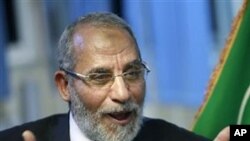
Abdel Mounoun Abdel Fouthouh, one of their leaders, says that for years, long-time rulers in the region, like Egyptian President Hosni Mubarak, have tried to prevent Islamist groups from gaining political ground.
He says they have done so by convincing their country's elites, as well as Western allies, that these groups would create violent cross-border networks and undermine stability in the Middle East.
"It is wrong because the Islamic groups, Islamic movements all over the world are modern and peaceful movements. It is a miserable thing that the Western regimes, especially the American one, is afraid of the Islamists. Yes, there are extremists in Islamic movements here and there, but the main bodies of the Islamic movements all over the world is a national and peaceful and moderate movement," he said.
Asked which candidate the Muslim Brotherhood would back in elections still scheduled for September, Fouthouh told VOA's French to Africa service that what matters is that free and fair elections do take place this year.
Elections are also due in Tunisia this year following the popular ouster of President Zine El Abidine Ben Ali, who ruled for more than two decades. Tunisian-born Radwan Masmoudi, the founder of the U.S. Center for the Study of Islam and Democracy, says it is crucial that the Islamist Ennahda movement, which has been banned as a political party, be allowed to take part.
"This is the real test for Tunisia, whether they will be able to bridge that gap between the secular parties and the Islamic parties and find a compromise that can satisfy everybody. I am very optimistic because I know the Ennahda party is a very moderate party, and has a history of moderation. Since they were founded in 1981, they were for democracy," he said.
The group's leader, Rachid Ghannouchi, returned to Tunisia Sunday after more than 20 years in exile. The group also did not lead the popular revolt in Tunisia, but hopes to do well in this year's general elections.
Ghannouchi said he would register his movement as a political party, while supporters who greeted him held up olive branches and copies of the Quran.
Some secular protesters were on hand as well and chanted slogans against any Islamist takeover. Experts on Islamist movements say Ennadha's ideology is more moderate than that of the Muslim Brotherhood.
Daniel Brumberg, an adviser with the U.S. Center for Conflict Analysis and Prevention, says that for the Islamist parties to have a future where they are accepted within their borders and by the international community, they need to show they will not be a repressive force.
"If you don't reach out and demonstrate to all concerned that the consequences of democracy is going to be freedom for all and that the victory of the majority or even the plurality is not a rationale for repressing others, you are going to get a reverse effect of the political elite, who may turn against the Islamists because they are afraid of the outcome of an election. So, you want to make sure you don't create that, so you can arrive at some sense of guarantees; so it is clearly a signal to all concerned that everybody will be safe and their basic freedoms protected as a consequence of a transition to democracy," he said.
Protests have also taken place in Algeria in recent days calling for a change of government there as well.
In early 1992, Algeria's military-led government voided elections after the first round and sweeping victories by Muslim fundamentalists, leading to a long civil war, and a state of emergency that remains to this day.