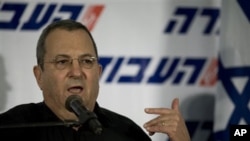
Israeli Defense Minister Ehud Barak has split from the center-left Labor Party in a move that some analysts say will strengthen the right-wing elements of Prime Minister Benjamin Netanyahu's governing coalition.
The departure of Ehud Barak from the Labor Party did not appear to threaten the stability of a governing coalition that analysts often describe as shaky because it includes both far-right and far-left elements.
Barak, a former prime minister, announced his decision to split from the Labor Party at a news conference.
He said he and his partners are creating a faction called Independence, a movement that will later be a party, one that he said will be centrist, Zionist, and democratic.
There have been sharp divisions within the Labor party over the lack of progress in peace negotiations with the Palestinians. Barak said he is tired of what he described as endless infighting.
He said many of his colleagues were victims of what he said were daily difficulties and a continuously unhealthy situation within the party.
Left-leaning members of the Labor Party have been pressuring Barak, a centrist, to push for more concessions in negotiations with the Palestinians or quit the government. The party was due to vote next month on whether to leave the coalition.
Barak is staying in the coalition under his new faction. Several other prominent Labor Party members including some Cabinet ministers have since announced they are joining him.
The Labor Party members remaining in the coalition are among the more dovish elements of the party who favor making concessions to the Palestinians in order to get stalled peace talks going again.
Analysts expected them to quit the government, leaving Prime Minister Benjamin Netanyahu's coalition with a smaller, but more stable block of hardliners.
Talks with the Palestinians stalled within a month after they started in September when Netanyahu's government refused to extend a Jewish settlement building freeze in the occupied West Bank.
Analysts say the split is another chapter in the demise of the Labor Party, which historically dominated Israeli politics.
"The Labor Party was the largest party in the Zionist movement," said Gideon Rahat, a politics professor at Hebrew University. "It led Israel to independence. It ruled Israel until 1977, so the real story here is the historical story. The story is one of a history of decline and this is an important event in the decline of the Labor Party."
The party is now a mid-sized faction that finished in fourth place in the 2009 elections. Some within the party accuse Barak of betraying the its pro-peace and socialist principles in favor of prevailing right-wing policies.
Israeli Defense Minister Barak Quits Political Party