


News / Middle East

Israelis, Palestinians Assess US Election Impact
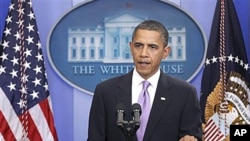
President Barack Obama makes a statement to reporters about the suspicious packages found on U.S. bound planes, in the James Brady Press Briefing Room of the White House in Washington (file photo - 29 Oct 2010)
TEXT SIZE - +

Israelis and Palestinians are assessing the impact of the U.S. midterm elections on bilateral relations and the Middle East peace process. 

Relations between Israel and the Obama administration have been tense because of disagreements over Jewish settlement expansion.  So the conventional wisdom is that the new Republican majority in the House of Representatives would help restrain a U.S. administration that many Israelis see as hostile.

But Israel's Deputy Foreign Minister Danny Ayalon sees things differently.

"Israel has always been a consensus; we are a bipartisan issue.  We have support from both Democrats and Republicans, so for Israel it does not matter whatsoever what party occupies the White House, what party has the majority in Congress," Ayalon said.

Many Palestinians agree.  They say the United States always supports Israel no matter which party is in power.  

A Palestinian businessman in East Jerusalem, Farouk Youssef, says the new U.S. Congress should take a more even-handed approach.

"I think the United States of America should think about the Palestinians," Youssef said.  "If the Israelis will insist in denying the rights of the Palestinians, I think the role of the United States should be more constructive."

Israeli political analyst David Ricci says the election weakened President Barack Obama, and that will translate into less U.S. involvement in the Middle East conflict.  

"Obama has these other big projects that he has to take care of first," noted Ricci.  "He has to take care of Iraq, he has to take care of Afghanistan, he has to take care of the economy, he has to take care of the health plan, he has to take care of the Democratic Party; and we are not very high on the list."

And since the United States is widely seen as the only one who can mediate an agreement, Ricci believes the U.S. elections do not bode well for the peace process.

You May Like

Experts Weigh In on Challenges of Closing Guantanamo Prison

Former chief military prosecutor at Guantanamo delivers petition to White House with more than 370,000 signatures, demanding facility be closed down immediately More

Karzai to Discuss Enhancing Defense Ties with India

Afghanistan looking for more military aid as it prepares for withdrawal of NATO forces by next year More

India, China Pledge to Overcome Border Tensions

Indian prime minister and Chinese premier attempt to move past tense standoff in the Himalayas during Delhi talks More

Burmese President Opens US Visit with VOA Town Hall Meeting

Ahead of his meeting with President Obama Monday, Thein Sein answered questions on human rights and economic development in his country More

This forum has been closed.
Comments
     
There are no comments in this forum. Be first and add one

Featured Videos

Your JavaScript is turned off or you have an old version of Adobe's Flash Player. Get the latest Flash player.
Video

Video US Oil Surge Could Impact Mideast Geopolitics

The United States will account for a third of new oil supplies over the next five years, and will become energy self-sufficient in 20 years, according to a new report by the Paris-based International Energy Agency (IEA). Although U.S. oil imports from Arab Gulf countries increased last year, analysts predict the U.S. will lose its dependence on Middle East imports, which is expected to have a huge impact on international relations and the balance of power. VOA's Henry Ridgewell reports.