


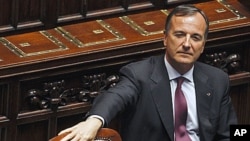
Italian Prime Minister Silvio Berlusconi has been under growing pressure from his party's much-needed ally, the Northern League, to decide an end date to withdraw from Libya. Italian Foreign Minister Franco Frattini spoke Wednesday about the NATO-led military operation.
Italian Prime Minister Silvio Berlusconi has been battling to keep his coalition together with an increasingly frustrated partner, the Northern League. The League has been demanding an end to Italy’s costly involvement in the NATO-led campaign in Libya. It also wants to see a resolution to the continuing arrival of immigrants from Libya on the Italian coastline.
Italian Foreign Minister Franco Frattini on Wednesday spoke about the ongoing hostilities in Libya. In particular, he addressed the need for humanitarian aid for the civilian population in the North African country.
Frattini’s comments were made to a parliamentary commission. His spokesman, Maurizio Massari, later outlined to the Arab television network Al Jazeera the Italian foreign minister’s position.
"What Minister Frattini said this morning was that if there is an appeal from international organizations such as African Union, Arab League, EU, UN for a humanitarian pause in order to allow unhindered and unrestricted access to humanitarian health to the civilian population, Italy will take into account with interest such an appeal," he said. "But of course, for that to happen, we would need broad international consensus, the consensus of our NATO partners and all the partners of the contact group."
Aid is needed mostly in areas around the Western stronghold of Misrata and around the Libyan capital, Tripoli. While Italy feels there is a need for at least a temporary pause in the hostilities, other countries like France and Britain disagree.
The NATO-led bombing campaign that began in March was aimed at protecting civilians under a United Nations resolution.
NATO Secretary General Anders Fogh Rasmussen says the alliance’s military operations in Libya will continue. He says this is because if they are interrupted, an infinite number of civilians would lose their lives.
Rasmussen added that he is deeply saddened by the loss of human life in this conflict. But he said it was the government of Libyan leader Moammar Gadhafi that began the conflict by attacking its own people - not NATO.
Related Video