



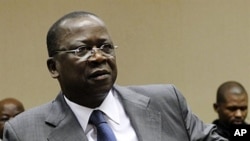
Ivory Coast's justice minister says he will ask prosecutors to investigate members of former president Laurent Gbagbo's government for various crimes.
Jeannot Ahoussou says ministers, generals and state radio and television journalists will be probed on charges of "blood crimes," corruption and propaganda.
On Saturday, the government of President Alassane Ouattara released nearly 70 of Gbagbo's family members and household staff, who were arrested when the presidential palace was stormed last week. Ahoussou said the 30 family members were to be taken to a secret location. Workers, including cooks and gardeners, were told to return to work Monday.
The release came as the leader of Gbagbo's Ivorian Popular Front called on supporters to lay down their arms and to stop fighting. He said the war has ended following Gbagbo's arrest on Monday in Abidjan.
Meanwhile, state radio reported Saturday that former interior minister, Desire Tagro, died on Tuesday after being shot and badly beaten during Monday's assault on Gbagbo loyalists.
Judicial proceedings have already been launched against Gbagbo, his wife and close associates. Government officials say Gbagbo is under house arrest at a villa somewhere in Ivory Coast, but have not said where.
President Ouattara has vowed to hold accountable all those who committed crimes during the post-election unrest.
Both pro-Gbagbo and pro-Ouattara forces have been accused of killing and raping civilians since the political crisis began last year. The International Criminal Court at The Hague says it is conducting a preliminary investigation into the crimes committed by both sides.
Gbagbo refused to give up power after losing a November presidential election to Ouattara. His refusal sparked a power struggle that the United Nations says killed hundreds of people and displaced more than a million, including 135,000 who fled into neighboring Liberia.
In the past week, a sense of normalcy has begun to return to Ivory Coast's main city of Abidjan. Running water and electricity have been restored in many neighborhoods and some shops and businesses have reopened their doors. However, food remains scarce and widespread looting is still taking place.
Some information for this report was provided by AP and AFP.