


The Ivory Coast battle over ambassadors has moved to Washington where supporters of internationally-recognized President Alasanne Ouattara apparently forced the Ivorian embassy to shut down. Incumbent Ivory Coast President Laurent Gbagbo is refusing to step down following elections in November, despite growing outside pressure including from diplomatic postings.
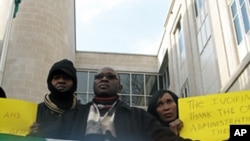
Protesters were hoping to storm the embassy and take down Mr. Gbagbo's photograph inside the Ivory Coast embassy in Washington.
But military guards refused them access, telling them the embassy was shut down for the holidays until January 3.
So instead the protesters put up a sign in French reading the "Ivory Coast ambassador has fled, Mr. Gbagbo is a rebel," outside the entrance.
Protesters had gotten a permit for the demonstration, and some said they believed this led to Ivorian authorities being alerted. Several police cars milled around.
But one of the protest organizers Yacouba Kone considered Thursday's action a victory.
"They decided to close because we were coming to do a demonstration, because they are scared of us," said Kone. "This is a victory for us because, running away, it is like a war, when you run away, you are scared, so we won. Surely they know that they are not [representing] the legitimate president of Ivory Coast so they are scared, and we will come back another day for the demonstration."
Several families and individuals who came by to pick up visas or deliver paperwork were turned away. A call to the embassy for comment was not answered.
Earlier in the week, an embassy spokesman said the ambassador previously appointed by Mr. Gbagbo, Charles Koffi was still at his desk working, but there was no sign of him at the compound on Thursday.
The protest in Washington follows similar protests around the world.
Countries where Ivorian embassies have been disrupted include France, Mali and Belgium, while this week an ambassador named by Mr. Ouattara received his credentials at the United Nations.
European countries and the United States have also said they are ready to work with diplomats appointed by Mr. Ouattara. Ivorian state media threatened that if that happens they will expel diplomats from those countries from Ivory Coast.
The Ivorian election commission and the United Nations declared Mr. Ouattara the winner in last month's election in an election partly organized by the world body. But the Ivorian constitutional council threw out votes from the Ivory Coast rebel-held north, giving victory to Mr. Gbagbo.
U.S.-based Africa analyst J. Peter Pham says although these diplomatic disputes are grabbing headlines, he does not believe they alter the balance of power in southern Ivory Coast, where Mr. Gbagbo still controls the army, cocoa fields, state media and ports.
"It does not solve [Mr.] Ouattara's basic problem," said Pham. "The fact is his base of support is in the north. He has very little support in the south in the military and in the government bureaucracy so even if [Mr.] Gbagbo bows out tomorrow he is going to have a very difficult time governing with a government bureaucracy that looks very suspiciously upon him."
Mr. Ouattara has gotten the reins of Ivorian accounts in international banks, trying to strangle the pay of government workers who support Mr. Gbagbo. He remains holed up in a hotel in the main southern commercial city Abidjan, under the protection of U.N. peacekeepers and former rebels.
Meanwhile, the incumbent president has recruited two high-profile French lawyers, Jacques Verges and Roland Dumas in his latest strategy to stay in power. His aides say he is trying to have his election victory upheld in West African and other international courts.
The U.N-sponsored election was supposed to end an eight-year division in Ivory Coast, but instead has exacerbated tensions and led to new violence, including repeated attacks by pro-Gbagbo forces targeting pro-Ouattara neighborhoods in Abidjan.
Ivory Coast Battle Over Embassies Moves to Washington