


Economic sanctions against Ivory Coast are hurting business in the world's top cocoa producer.
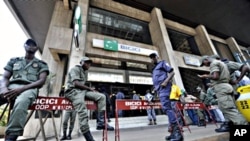
Thousands of civil servants line up along Abidjan's Rue des Banques, waiting to be paid their February salaries. When foreign banks closed last month because of regional sanctions against incumbent President Laurent Gbagbo, his government faced its biggest economic challenge yet: finding the cash to pay its workers, especially its soldiers.
Gbagbo's government quickly took charge of those banks and reopened them this week, just in time to pay civil servants 80 percent of their normal salaries.
"That will be a great success. I am sure they will be able to do it," said English teacher Ibrahim Kalo. He says the regional central bank move to cut off the Gbagbo government was a challenge to all Ivorians - a challenge that has been met.
"I think this was an operation to diabolize [demonize] the government of Cote d'Ivoire,” Kalo added. “But I think they can pay us. That is why we are standing now in the queue. You can see from all the banks here long lines of people waiting for money, and they will be paid. You can be sure of that. There is no trouble."
Winceslas Appia, general manager of Abidjan's Bank for Agricultural Financing says there is enough cash to take care of everyone. So people should remain calm, he said. Appia said the banks have put in place measures to reinforce their staff so everyone will be served.
Withdrawals limited
Personal withdrawals are limited to about $425 a day. Gbagbo's Minister of Economy and Finance, Desire Dallo says those limits are meant to help the banking system stay solvent.
Dallo is asking people not to withdraw all their money because the banking system works only if there is a balance between deposits and loans. Dallo said it is obvious that people are afraid that banks will close again. But he said these are now state-run banks that will not fail, so account holders should not panic and withdraw all their money because that will not help.
Why sanctions?
Economic sanctions are meant to drive Gbagbo from power after he claimed re-election in last November's disputed presidential runoff. The constitutional council annulled nearly 10 percent of the ballots as fraudulent. Ivory Coast's electoral commission and the United Nations certified results that say former Prime Minister Alassane Ouattara won that vote.
Ouattara's call for a ban on cocoa exports has brought most of that industry to a halt, denying the Gbagbo government an important source of tax revenue. Sanctions have led to a shortage of cooking gas and the collapse of money transfers and credit cards, making Ivory Coast a cash-only economy.
Economic impact
Senegalese businessman Mouctar Bah sells mobile phones in Abidjan's Treichville neighborhood.
Bah says Seneglese merchants were in Ivory Coast when it was good. Now nothing is working. There is not Western Union or banks to transfer money. Businessmen are not politicians, Bah says, so when things are not working, it is time to leave.
At a Total Petrol station on Boulevard du General DeGaulle, motorists are no longer allowed to buy fuel in jerry cans. It is part of a government campaign to prevent hoarding as Abidjan's refinery is reducing production because it is having trouble buying crude.
Effective?
Ouattara supporters say sanctions against Gbagbo are working, though more slowly than they hoped.
"We will see that the effects will be quite remarkable,” said Jean-Marie Kacou Gervais, Ouattara's foreign minister. “We can't see it by now, but it's on. And I am sure he will not be able to stand the heat when the time comes."
Even those who do not recognize Gbagbo's authority agree that his is the de facto government in Ivory Coast so long as it pays its soldiers.
"He has the army and he also has got the finance to pay,” said Hamadoun Toure, the United Nations mission spokesman. “As long as he has the two powers, he will be in control of the situation."
Pro-Gbagbo parliamentarian Bamba Massany says Ivorians will not be cowed by the international community.
Massany said sanctions against the Gbagbo government are inhuman and nonsensical. Now is the time for people to help the government, as Massany said it is working to strengthen Ivory Coast's economic foundations.