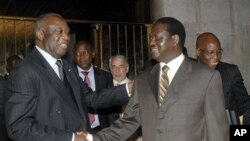
Incumbent Ivorian President Laurent Gbagbo, continues to cling to power following a November poll the United Nations and much of the international community say was won by former prime minister Alassane Ouattara.
African Union mediator and Kenyan Prime Minister, Raila Odinga, left Abidjan on Wednesday, after what he said were extensive discussions with Mr. Gbabgo and Mr. Ouattara. But he says the breakthrough needed to resolve the political crisis did not happen because Mr. Gbagbo refused to discuss stepping down and twice broke a promise to lift a blockade of Mr. Ouattara's hotel.
"I have today told him that the window for negotiations is closing fast, that time is running out for him," Odinga said, "that if he does not take the offer, which we are giving him, then he runs the risk of being removed from power through other means, which includes sustained economic sanctions which will isolate the country completely or use of legitimate force to get him out of power."
After leaving Ivory Coast, Mr. Odinga met Wednesday with heads of state in Ghana, Mali and Burkina Faso to brief them on the situation.
Mr. Gbagbo's foreign minister, Alcide Djedje, said the government will no longer receive Mr. Odinga.
Djedje says Mr. Odinga has become a participant in the Ivorian crisis and can therefore no longer serve as a special envoy of the African Union. Djedje says Mr. Odinga has taken Mr. Ouattara's side and is now trying to convince heads of state who are favorable to Mr. Gbagbo to withdraw their support.
Ghana and Angola have shown support for Mr. Gbabgo, but Burkina Faso has kept to the policy of West African leaders that Mr. Gbagbo must step down.
The Economic Community of West African States, ECOWAS, says it is considering military action to remove Mr. Gbagbo. Earlier this month, Ghanian President John Atta Mills said his country would not participate in such an effort.
The African Union, the United Nations, the European Union, and the United States recognize Mr. Ouattara's victory and say Mr. Gbagbo must leave. Mr. Gbagbo says he was re-elected when his political allies on the constitutional council annulled enough Ouattara votes to put him ahead.
Wednesday, the U.N. Security Council unanimously approved an additional 2,000 peacekeepers for Ivory Coast, boosting the total U.N. force to 12,000 troops.
The U.N. human rights office says violence during the post-electoral crisis has killed at least 247 people in Ivory Coast.
Ivory Coast Timeline
Ivory Coast Mediator Warns of Violence, While Continuing Diplomacy
- By Anne Look