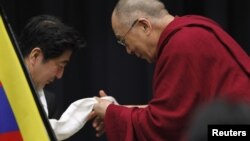
The man who could become Japan's next prime minister met with the Dalai Lama Tuesday and called for freedom in Tibet, prompting an immediate protest by the Chinese government.
Former prime minister Shinzo Abe, an outspoken nationalist who has been critical of Beijing, joined around 130 other parliamentarians in welcoming the exiled Tibetan spiritual leader to a meeting in Tokyo.
"We lawmakers here are in complete agreement, that we want to help the suffering Tibetan people and help create a Tibet in which people do not have to kill themselves in a quest for freedom," he said.
Speaking at the meeting, the Dalai Lama invited Japanese parliamentarians to visit Tibet to find out the reasons for a wave of self-immolations by Tibetans. He also called on Chinese authorities to conduct a "thorough investigation" into the protests against Chinese rule.
China's reaction
In response, Chinese Foreign Ministry spokesperson Hong Lei blasted both the Dalai Lama and the Japanese government, saying both were encouraging extremist separatist groups.
"Japan's right wing openly supports the Dalai Lama's anti-China, separatist actions and interferes with China's internal policies. China strongly condemns this," said Hong Lei. "The Japanese government indulges the Dalai Lama's separatist movements and the right wing's anti-Chinese actions, betrays the principle and spirit of mutual benefit between China and Japan. China has already launched a protest."
Japan-China relations were already strained in recent months after Tokyo nationalized a group of uninhabited East China Sea islands at the center of a long-running dispute between the two Asian neighbors.
Self-immolations
Tuesday's meeting, which was not sponsored by the Tokyo government, occurred after two more Tibetans set themselves on fire to protest China's policies.
VOA Tibetan service says 24-year-old Nyingkar Tashi set himself on fire in front of a school in a town in Rebkong, an area called Tongren by the Chinese. Witnesses say he called for the return of the Dalai Lama and freedom for Tibet before he died.
A second man, 18-year-old Nyangchak Bhum, set himself on fire and died several hours later in front of Chinese government offices in Dowa, also in the Rebkong region.
Witnesses say in both cases large crowd gathered after the self-immolations to say prayers.
Monday's self-immolations bring the total since February 2009 to 72, with the last nine coming since just last week. In 58 cases, the protesters have died.
The self-immolations coincide with China's 18th Party Congress in Beijing and the country's once-in-a-decade leadership transition.
China has long accused Tibetan exiles of self-immolating as part of a separatist struggle, denouncing them as terrorists.
Former prime minister Shinzo Abe, an outspoken nationalist who has been critical of Beijing, joined around 130 other parliamentarians in welcoming the exiled Tibetan spiritual leader to a meeting in Tokyo.
"We lawmakers here are in complete agreement, that we want to help the suffering Tibetan people and help create a Tibet in which people do not have to kill themselves in a quest for freedom," he said.
Speaking at the meeting, the Dalai Lama invited Japanese parliamentarians to visit Tibet to find out the reasons for a wave of self-immolations by Tibetans. He also called on Chinese authorities to conduct a "thorough investigation" into the protests against Chinese rule.
China's reaction
In response, Chinese Foreign Ministry spokesperson Hong Lei blasted both the Dalai Lama and the Japanese government, saying both were encouraging extremist separatist groups.
"Japan's right wing openly supports the Dalai Lama's anti-China, separatist actions and interferes with China's internal policies. China strongly condemns this," said Hong Lei. "The Japanese government indulges the Dalai Lama's separatist movements and the right wing's anti-Chinese actions, betrays the principle and spirit of mutual benefit between China and Japan. China has already launched a protest."
Japan-China relations were already strained in recent months after Tokyo nationalized a group of uninhabited East China Sea islands at the center of a long-running dispute between the two Asian neighbors.
Self-immolations
Tuesday's meeting, which was not sponsored by the Tokyo government, occurred after two more Tibetans set themselves on fire to protest China's policies.
VOA Tibetan service says 24-year-old Nyingkar Tashi set himself on fire in front of a school in a town in Rebkong, an area called Tongren by the Chinese. Witnesses say he called for the return of the Dalai Lama and freedom for Tibet before he died.
A second man, 18-year-old Nyangchak Bhum, set himself on fire and died several hours later in front of Chinese government offices in Dowa, also in the Rebkong region.
Witnesses say in both cases large crowd gathered after the self-immolations to say prayers.
Monday's self-immolations bring the total since February 2009 to 72, with the last nine coming since just last week. In 58 cases, the protesters have died.
The self-immolations coincide with China's 18th Party Congress in Beijing and the country's once-in-a-decade leadership transition.
China has long accused Tibetan exiles of self-immolating as part of a separatist struggle, denouncing them as terrorists.
Some information for this report was provided by AP, AFP and Reuters.