Japanese Prime Minister Shinzo Abe has unveiled a massive stimulus plan aimed at revitalizing the world's third largest economy.
Abe said the $117 billion stimulus package approved Friday would bring an immediate boost to the long-struggling economy, which fell back into recession last year.
"These measures will push up Japan's real GDP by around two percent and create jobs for approximately 600,000 people. This economic strategy is full-fledged, proving our strong will and clear commitment toward economic reform," Abe said.
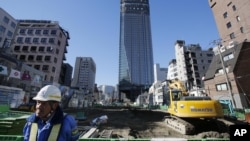
The plan will increase spending on disaster recovery projects, public works, and financial aid to small businesses. It also proposes boosting defense spending for the first time in a decade.
It fulfills a major campaign promise for Abe, who came to power in a landslide election last month, vowing to boost Japan's economy and create jobs with big government spending plans.
While the stimulus is likely to have a positive short-term effect, many skeptics warn it will not foster long-term growth and will add to Japan's government debt, which is more than 200 percent of its gross domestic product.
Jiro Yamaguchi, a political science professor at Japan's Hokkaido University, says the plan is similar to that of previous governments, who tried unsuccessfully to spur economic growth.
"The previous Democratic Party government did similar policies, especially about the reconstruction after the earthquake. They spent a lot, but the system of implementation is quite outdated," he explained. "Abe just tried to add more money, but the target is very similar. His new package will not change the economic structure or provide innovation in the Japanese economy."
The stimulus includes a plan to increase spending on missiles, fighter jets, and helicopters to increase the capacity of the military. It comes as Tokyo is engaged in a bitter dispute with China over a group of uninhabited islands in the East China Sea.
The dispute has worsened in recent months, and there has been worry that Abe, who is known for his sometimes hawkish and nationalistic views, would not help the situation.
But David Fouse, a Japan analyst at the Hawaii-based Asia/Pacific Center for Security Studies, downplayed the significance of Abe's move to boost military spending.
"There's been a steady downtrend in Japan's defense spending. I think this is just a very moderate increase...I don't think it's going to be a major increase for what Japan can do with its military," he said.
But Abe on Friday continued his tough stance on China, saying it was "wrong" for Beijing to allow violent protests against Japanese businesses over the territorial dispute.
The protests erupted last year after Tokyo angered Beijing by purchasing some of the disputed islands from their Japanese landowner. The dispute has negatively affected trade between China and Japan, Asia's two largest economies.
Abe said the $117 billion stimulus package approved Friday would bring an immediate boost to the long-struggling economy, which fell back into recession last year.
"These measures will push up Japan's real GDP by around two percent and create jobs for approximately 600,000 people. This economic strategy is full-fledged, proving our strong will and clear commitment toward economic reform," Abe said.
The plan will increase spending on disaster recovery projects, public works, and financial aid to small businesses. It also proposes boosting defense spending for the first time in a decade.
It fulfills a major campaign promise for Abe, who came to power in a landslide election last month, vowing to boost Japan's economy and create jobs with big government spending plans.
While the stimulus is likely to have a positive short-term effect, many skeptics warn it will not foster long-term growth and will add to Japan's government debt, which is more than 200 percent of its gross domestic product.
Jiro Yamaguchi, a political science professor at Japan's Hokkaido University, says the plan is similar to that of previous governments, who tried unsuccessfully to spur economic growth.
"The previous Democratic Party government did similar policies, especially about the reconstruction after the earthquake. They spent a lot, but the system of implementation is quite outdated," he explained. "Abe just tried to add more money, but the target is very similar. His new package will not change the economic structure or provide innovation in the Japanese economy."
The stimulus includes a plan to increase spending on missiles, fighter jets, and helicopters to increase the capacity of the military. It comes as Tokyo is engaged in a bitter dispute with China over a group of uninhabited islands in the East China Sea.
The dispute has worsened in recent months, and there has been worry that Abe, who is known for his sometimes hawkish and nationalistic views, would not help the situation.
But David Fouse, a Japan analyst at the Hawaii-based Asia/Pacific Center for Security Studies, downplayed the significance of Abe's move to boost military spending.
"There's been a steady downtrend in Japan's defense spending. I think this is just a very moderate increase...I don't think it's going to be a major increase for what Japan can do with its military," he said.
But Abe on Friday continued his tough stance on China, saying it was "wrong" for Beijing to allow violent protests against Japanese businesses over the territorial dispute.
The protests erupted last year after Tokyo angered Beijing by purchasing some of the disputed islands from their Japanese landowner. The dispute has negatively affected trade between China and Japan, Asia's two largest economies.