TOKYO - Japan is breathing a long-awaited sigh of relief.
A newspaper seller hawked an extra edition Friday afternoon with a banner headline that the country's last remaining top fugitive has been apprehended.
The announcement was formally made at the Tokyo Metropolitan Police Department by chief criminal investigator Naomasa Yoshida.
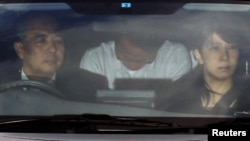
The police official said Katsuya Takahashi, 54, on the special Most Wanted list, has been taken into custody following a manhunt that began in 1995 and served with an arrest warrant for murder and attempted murder.
Takahashi was apprehended in a comic book cafe in the capital after police received a tip the Aum Shinrikyo cult member was there. Police quoted Takahashi as saying he was carrying the equivalent of $60,000 in cash.
His arrest comes less than two weeks after one of his former colleagues, Naoko Kikuchi, was captured. Her arrest revealed that Takahashi had been working for a construction company in nearby Kawasaki.
On the last day of 2011, former senior cult official Makoto Hirata surrendered to police.
Hirata, Kikuchi and Takahashi had been on a special wanted list. For more than a decade their faces were ubiquitous, on police posters in public spaces across the country.
They were accused of taking part in the release of sarin gas in train cars on the Tokyo subway system during the morning rush hour on March 20, 1995. Twelve people died and thousands more were poisoned.
The cult's founder, Shoko Asahara (whose real name is Chizuo
Matsumoto) has been sentenced to death by hanging for those killings and 15 others blamed on the group. Eleven other Aum members have also been convicted of murder and sentenced to die.
Asahara, who is legally blind, at one time had a following numbering in the thousands. He told cult members he wanted them to help unleash turmoil that would trigger a third world war so they could seize power and take over Japan.
The cult had earlier considered building a nuclear bomb, but when that proved impossible it chose instead to focus on chemical weapons. Aum was able to manufacture sarin, a clear, colorless, and tasteless nerve gas that it unleashed on perceived enemies before its big attack on the Tokyo subway system.
A newspaper seller hawked an extra edition Friday afternoon with a banner headline that the country's last remaining top fugitive has been apprehended.
The announcement was formally made at the Tokyo Metropolitan Police Department by chief criminal investigator Naomasa Yoshida.
The police official said Katsuya Takahashi, 54, on the special Most Wanted list, has been taken into custody following a manhunt that began in 1995 and served with an arrest warrant for murder and attempted murder.
Takahashi was apprehended in a comic book cafe in the capital after police received a tip the Aum Shinrikyo cult member was there. Police quoted Takahashi as saying he was carrying the equivalent of $60,000 in cash.
His arrest comes less than two weeks after one of his former colleagues, Naoko Kikuchi, was captured. Her arrest revealed that Takahashi had been working for a construction company in nearby Kawasaki.
On the last day of 2011, former senior cult official Makoto Hirata surrendered to police.
Hirata, Kikuchi and Takahashi had been on a special wanted list. For more than a decade their faces were ubiquitous, on police posters in public spaces across the country.
They were accused of taking part in the release of sarin gas in train cars on the Tokyo subway system during the morning rush hour on March 20, 1995. Twelve people died and thousands more were poisoned.
The cult's founder, Shoko Asahara (whose real name is Chizuo
Matsumoto) has been sentenced to death by hanging for those killings and 15 others blamed on the group. Eleven other Aum members have also been convicted of murder and sentenced to die.
Asahara, who is legally blind, at one time had a following numbering in the thousands. He told cult members he wanted them to help unleash turmoil that would trigger a third world war so they could seize power and take over Japan.
The cult had earlier considered building a nuclear bomb, but when that proved impossible it chose instead to focus on chemical weapons. Aum was able to manufacture sarin, a clear, colorless, and tasteless nerve gas that it unleashed on perceived enemies before its big attack on the Tokyo subway system.