


News / Africa

Japan Commemorates 6 Months Since Disasters
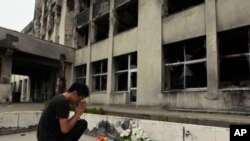
Yuki Omori, 23, prays at a makeshift shrine at Kadowaki Elementary School in Ishinomaki, northeastern Japan, September 11, 2011, six months after the March 11 earthquake.
TEXT SIZE - +

Japan fell silent Sunday in a solemn minute of prayer and reflection marking six months since the massive earthquake and tsunami that left 20,000 people dead or missing and sparked a nuclear crisis.

Sirens wailed at 2:46 in the afternoon as tens of thousands of mourners, many of them dressed in black, gathered to remember the dead in towns and villages along the country's devastated northeastern coast.

In the city of Ishinomaki, mourners gathered on a hill overlooking wrecked homes and businesses to pray for the nearly 4,000 people who died there on March 11, when towering waves swept away whole sectors of the coastal city. Organizers displayed 18,000 letters from children in the form of a giant rainbow spread across the ground.

Similar observances took place in towns and villages in Iwate and Fukushima prefectures, while hundreds of Tokyo residents staged anti-nuclear protests.

The magnitude 9.0 earthquake produced devastation not seen in Japan since World War Two, with the accompanying tsunami swallowing entire towns. The waves flooded the Fukushima nuclear power plant, triggering the worst nuclear crisis since the Chernobyl disaster of 1986.

Political fallout from the disasters forced Prime Minister Naoto Kan from office amid widespread accusations his government downplayed the scale of the nuclear crisis.

Authorities say 83,000 people remain in temporary homes six months after the disasters.  Nearly 7,000 people are reported still living in disaster shelters, as radiation fears from the shuttered Fukushima plant prevent area residents from returning home.

Police say the remains of 1,106 people remain unidentified.

You May Like

India, China Pledge to Overcome Border Tensions

Indian prime minister and Chinese premier attempt to move past tense standoff in the Himalayas during Delhi talks More

Burmese President Opens US Visit with VOA Town Hall Meeting

Ahead of his meeting with President Obama Monday, Thein Sein answered questions on human rights and economic development in his country More

Video Washington Week: Focus on Burma, US Government Scandals

President Thein Sein visits the White House on Monday, Congressional probes of multiple scandals are continuing More

This forum has been closed.
Comments
     
There are no comments in this forum. Be first and add one

Featured Videos

Your JavaScript is turned off or you have an old version of Adobe's Flash Player. Get the latest Flash player.
Video

Video Boston Bomber Spent 6 Months in Russia’s Most Violent Republic

The news of the Boston Marathon bombings circled the globe, and resonated here in Dagestan, a majority Muslim republic in Russia, on the shores of the Caspian Sea. Last year, Tamerlan Tsarnaev, the older of two brothers suspected of the bombings and a long-time Boston resident, returned to Dagestan, where he had lived for a year during his youth. Dagestan was the land of his maternal ancestors. But in the last two years, this republic of 3 million people has gained notoriety as the region with the highest level of political and religious violence in all of Russia. VOA's James Brooke reports from Makhachkala, Russia.