



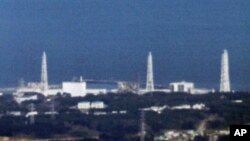
Japan is continuing its attempts to cool damaged reactors and exposed fuel rods at the crippled coastal nuclear power plant hit by the tsunami following the magnitude nine earthquake a week ago.
Japan's Prime Minister, Naoto Kan spoke bluntly when a reporter Friday evening asked him about the situation at the Fukushima-1 nuclear power plant.
The prime minister says it is "very grave" and people are risking their lives at the crippled plant. But Kan expresses confidence that things will be resolved soon.
He made the remark hours after personnel in fire trucks sprayed water on damaged reactor buildings, making what is considered a risky attempt to cool highly radioactive fuel rods.
Powerful hoses were used to shoot 50 tons of water directly on the buildings, but the military and civilian firefighters have to keep their distance and limit the time they can be inside the complex because of the radiation. The military appears to have given up trying to repeat Thursday's water drops, by helicopter, on the damaged reactor buildings.
Meanwhile, utility workers are extending an emergency power cable to the 40-year-old complex. That would allow a steady supply of electricity to run water pumps. But government officials say it could be Sunday before cooling units can be re-started at the number two and three reactors.
Since the earthquake and tsunami a week ago, fires, explosions and partial melting of cores have been experienced at four of the six reactors at the Fukushima-1 plant.
Officials say the number three reactor remains the priority. Mixed oxide (MOX) fuel rods, partly composed of especially toxic plutonium are partially exposed. Without water they will continue to heat and potentially spew radiation beyond the coastal facility.
The Los Angeles Times and The New York Times newspapers report that there is a hole in either the floor or sides of the spent fuel pool of the Number 4 reactor. That would present another serious challenge to keeping the rods from being exposed.
Japan's government says although elevated levels of radiation are being detected kilometers away from the crippled plant, they do not pose a risk to human health.
People as far away as Tokyo are not reassured. Families have decided to head to Osaka or farther south and west. Many flights to surrounding countries are reported full with people trying to leave Japan amid news reports of the possibility of meltdowns. Some foreigners say they are also worried because food and other items in markets quickly vanished from shelves.
A number of foreign governments, including the United States, are making chartered aircraft available from the capital for their nationals who want to flee the country.
Some Japanese observers call the radiation fears by those in Tokyo an overreaction, noting those returning home overseas would be exposed to higher levels during the high-altitude flights than if they stayed put.