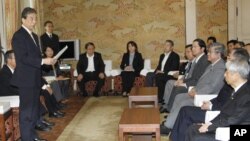
Kiyoshi Kurokawa, left, chairman of the Fukushima Nuclear Accident Independent Investigation Commission, speaks to lawmakers before handing over its final report to Lower House Chairman Takahiro Yokomichi, July 5, 2012.
TOKYO — A parliamentary report in Japan concludes the meltdowns last year at the Fukushima nuclear power plant were clearly a man-made disaster, and that the facility was vulnerable to earthquakes.
The six-month parliamentary investigation casts blame on both the Japanese government and Tokyo Electric Power Company for the Fukushima reactor meltdowns.
The report says collusion between the power company and nuclear regulators led to a lack of safety measures that could have mitigated the disaster - the world's worst nuclear accident since the Chernobyl meltdown in Ukraine in the former Soviet Union in 1986.
The Japanese disaster began March 11 last year when a magnitude nine earthquake and resulting tsunami struck the country's northeastern coast.
The report indicates the earthquake may have damaged critical equipment in the plant, contradicting the utility's assertion that it was the 20-meter-high tsunami - an event the power company never anticipated - which crippled the facility.
The chairman of the investigation commission, Kiyoshi Kurokawa, professor emeritus at Tokyo University, released the 600-page report in Tokyo Thursday.
He says his committee managed to compile the report within six short months but it is thorough and verifiable.
Kurokawa's comments included in the report were more pointed than his remarks to reporters. He wrote the nuclear accident's “fundamental causes are to be found in the ingrained conventions of Japanese culture: our reflexive obedience; our reluctance to question authority; our devotion to ‘sticking with the program’; our 'groupism'; and our insularity.”
The report singles out for some of the blame then-Prime Minister Naoto Kan for interfering at a critical time and causing confusion in the chain of command at the crippled nuclear plant.
The report makes seven proposals, including tougher scrutiny of power companies, and details requirements for a new nuclear regulatory organization.
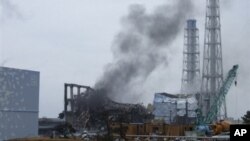
Smoke rising from Unit 3 of the tsunami-stricken Fukushima Dai-ichi nuclear power plant, Okumamachi, Japan, March 21, 2011.
A member of parliament from the opposition Liberal Democratic Party, Taro Kono, is expressing concern about whether the five members to be appointed to the new oversight body will truly be independent.
“If we get the wrong guys it's going to be the same old thing," he said. "Nobody trusts the nuclear policy or administration right now and what we have to do is to restore the credibility of the nuclear regulations [and the] regulatory organization. And what the government is doing is totally destroying that from square one.”
The government, despite public protests, is beginning to bring suspended nuclear plants back to life.
That disappoints some lawmakers, such as Kono, who says the governing Democratic Party is beholden to the powerful labor unions representing the utility workers while many in his own party rely on donations from those tied to the nuclear industry.
The release of the parliamentary report came just hours after the first nuclear reactor resumed supplying electricity to the public since the Fukushima meltdowns.
That is the sound in the control room as the number three reactor at the Oi plant, owned by Kansai Electric Power, goes back online. It is expected to reach its full output of 1,180 megawatts in about four days.
All of Japan's other 50 commercial reactors remain idled for maintenance and safety checks.
Resource-poor Japan, prior to the Fukushima disaster, relied on atomic energy for nearly one-third of its electricity.
On a day featuring momentous events regarding the nuclear industry in Japan, newspapers here issued rare afternoon extra editions. But they did not deal with this matter - rather the papers heralded the birth of a panda cub at Tokyo's Ueno Zoo.
The Voice of America provides news and information in more than 40 languages to an estimated weekly audience of over 326 million people. Stories with the VOA News byline are the work of multiple VOA journalists and may contain information from wire service reports.