



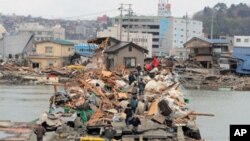
Japan's central bank moved quickly Monday to reassure investors that sufficient money will be available to rebuild the nation's quake-damaged economy, injecting nearly $200 billion to stabilize financial markets. But the economic damage from Japan's worst earthquake ever recorded may be more severe than first thought. Although the full impact won't be known for some time, analysts say it could take years for the world's third-largest economy to recover.
Last Friday's massive quake could well be the most expensive natural disaster in Japan's history. Already saddled with a huge debt and a shrinking economy, Japan's central bank announced it is pumping $183 billion into money markets to keep interest rates low and to make sure banks have adequate funds for emergency activities and rebuilding.
Central bank governor Masaaki Shirakawa spoke to reporters Sunday night.
"The Bank of Japan will do its best to ensure stability of the financial markets and supply adequate liquidity. Rest assured that the central bank and commercial banks will work together to provide enough cash," Shirakawa said.
But the triple blow to Japan's economy - the massive earthquake, deadly tsunami and now the threat of multiple nuclear meltdowns - could complicate the recovery.
Worries about the threat of massive power disruptions to Japanese factories triggered a broad sell-off in the Tokyo stock exchange, sending the Nikkei index to its lowest level in four months.
Tokyo economist Takuji Okubo says the disruptions are especially problematic in manufacturing-intensive economies such as Japan.
"I would say the biggest risk is power,” Okubo states. “If Japan is to lose relatively permanently, say for like a year, 10-20 percent of power generation, I think that would be severely negative for the economy."
It's a huge blow for Japan, which last year lost its standing to China as the world's second-largest economy. Investment strategist Shinichi Ichikawa says the entire country is affected.
"So you know the impact is pretty much expanding, not only in the northeast area of Japan, but also the capital city, Tokyo. And you know that some of the infrastructure in Tokyo should have been pretty much impacted,” Ichikawa explains. “So that is why nobody can know the real economic impact from this earthquake."
Those who survived the quake know the scale of their tragedy, as many as 10,000 are feared dead. Millions are without power.
In Supermarkets, shoppers scan empty store shelves looking for basic goods.
And in Tokyo's normally busy streets, traffic is sparse as motorists’ line up for fuel.
The magnitude of the disaster is evident to all.
Analysts say the nation's growth will likely fall short, as business and industry cope with power shortages and damaged transportation facilities. But in the long run, economists say the need to rebuild damaged cities and infrastructure will help Japan recover from the country's worst crisis since the World War II.