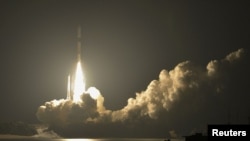
SEOUL - Early Friday, Japan successfully launched a South Korean satellite. The historical accomplishment puts the Japanese in the same arena as European and Russian entities in the lucrative commercial space launch business.
The roar of the H-2A launch vehicle shattered the early morning silence On the southern Japanese island of Tanegashima. The space center was illuminated as the liquid-fueled 57-meter high two-stage rocket rose off the pad with four satellites on board.
Sixteen minutes after launch, the Japan Aerospace Exploration Agency (JAXA) announced the first payload had successfully separated.
The Arirang-3 satellite (also known as KOMPSAT-3) was then placed into orbit. The Korean Aerospace Research Institute (KARI) says it is functioning normally.
Also deployed Friday from the H-2A rocket was a satellite with the world's largest revolving antenna. The Advanced Microwave Scanning Radiometer 2 (AMSR2) is able to measure water temperature from the sea surface with an accuracy of 0.5 degrees Celsius.
Scientists say the Japanese satellite, nick-named “Shizuku,” will play an important role in monitoring global water circulation and climate change.
Capturing the most attention internationally, however, is the
cooperation between Japan and South Korea in space exploration.
Japan not only demonstrated its 15th consecutive successful launch of its main large-scale indigenous rocket (built by Mitsubishi Heavy Industries), it also collected tens of millions of dollars from a foreign customer, offering a lower bid than Russia to launch the South Korean satellite.
Japan thus achieves its long-time goal of joining the elite and
highly lucrative - but risky - commercial space launch business.
South Korea has now demonstrated it can develop and assemble state-of-the-art, lightweight, multi-use earth observation satellites.
Arirang-3 carries a high-resolution optical imager purchased from
Astrium, a subsidiary of Europe's leading space company. From an altitude of nearly 700 kilometers, it can capture objects on the ground less than one meter in length.
Kang Kyung-in, the principal researcher at South Korea's KAIST Satellite Technology Research Center, says Arirang-3 will be able to monitor nearly any spot on Earth.
Kang says the remote sensing satellite is not intended to exclusively monitor any particular country (namely North Korea), nor is it exclusively for government use. He expects that some of the data may also be utilized by businesses amid an increasing demand for such high-resolution images.
Analysts, however, point out that, in essence, South Korea now likely has its most sophisticated indigenous device to monitor rival North Korea for military and intelligence purposes. Until now, South Korea has had to rely on its lower resolution satellites or images delivered by its ally, the United States, or other friendly countries with the best resolution space cameras.
The joint Japanese-South Korean event comes just a month after North Korea failed in its third attempt to place into orbit what it said was an earth observation satellite.
Researcher Kang says North Korea's technology is at least 20 years behind the South's and Pyongyang's motives are suspect.
Kang says the April 13th North Korean launch attempt probably was not primarily to deploy a peaceful satellite, as declared, but rather to test its rocket technology which could be utilized to launch multi-stage missiles.
Envoys from South Korea, Japan and the United States are to meet in Seoul Monday to discuss the failed North Korean launch amid concerns the reclusive and impoverished country may also be preparing an attempted third nuclear test.
The roar of the H-2A launch vehicle shattered the early morning silence On the southern Japanese island of Tanegashima. The space center was illuminated as the liquid-fueled 57-meter high two-stage rocket rose off the pad with four satellites on board.
Sixteen minutes after launch, the Japan Aerospace Exploration Agency (JAXA) announced the first payload had successfully separated.
The Arirang-3 satellite (also known as KOMPSAT-3) was then placed into orbit. The Korean Aerospace Research Institute (KARI) says it is functioning normally.
Also deployed Friday from the H-2A rocket was a satellite with the world's largest revolving antenna. The Advanced Microwave Scanning Radiometer 2 (AMSR2) is able to measure water temperature from the sea surface with an accuracy of 0.5 degrees Celsius.
Scientists say the Japanese satellite, nick-named “Shizuku,” will play an important role in monitoring global water circulation and climate change.
Capturing the most attention internationally, however, is the
cooperation between Japan and South Korea in space exploration.
Japan not only demonstrated its 15th consecutive successful launch of its main large-scale indigenous rocket (built by Mitsubishi Heavy Industries), it also collected tens of millions of dollars from a foreign customer, offering a lower bid than Russia to launch the South Korean satellite.
Japan thus achieves its long-time goal of joining the elite and
highly lucrative - but risky - commercial space launch business.
South Korea has now demonstrated it can develop and assemble state-of-the-art, lightweight, multi-use earth observation satellites.
Arirang-3 carries a high-resolution optical imager purchased from
Astrium, a subsidiary of Europe's leading space company. From an altitude of nearly 700 kilometers, it can capture objects on the ground less than one meter in length.
Kang Kyung-in, the principal researcher at South Korea's KAIST Satellite Technology Research Center, says Arirang-3 will be able to monitor nearly any spot on Earth.
Kang says the remote sensing satellite is not intended to exclusively monitor any particular country (namely North Korea), nor is it exclusively for government use. He expects that some of the data may also be utilized by businesses amid an increasing demand for such high-resolution images.
Analysts, however, point out that, in essence, South Korea now likely has its most sophisticated indigenous device to monitor rival North Korea for military and intelligence purposes. Until now, South Korea has had to rely on its lower resolution satellites or images delivered by its ally, the United States, or other friendly countries with the best resolution space cameras.
The joint Japanese-South Korean event comes just a month after North Korea failed in its third attempt to place into orbit what it said was an earth observation satellite.
Researcher Kang says North Korea's technology is at least 20 years behind the South's and Pyongyang's motives are suspect.
Kang says the April 13th North Korean launch attempt probably was not primarily to deploy a peaceful satellite, as declared, but rather to test its rocket technology which could be utilized to launch multi-stage missiles.
Envoys from South Korea, Japan and the United States are to meet in Seoul Monday to discuss the failed North Korean launch amid concerns the reclusive and impoverished country may also be preparing an attempted third nuclear test.