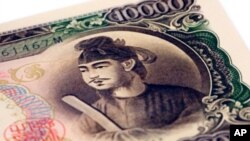
Japan's government and the country's central bank took action Thursday to dilute the yen. The Japanese currency’s strong standing against the dollar is making exports more expensive, hurting efforts to revive the country's moribund economy.
After many days of repeated statements by top Japanese government officials expressing alarm about the surging yen, which they blame mainly on currency speculators, rhetoric was converted into action.
The Finance Ministry acknowledges buying dollars during Thursday Asia trading. That move, the first such intervention by Tokyo in half a year, quickly sent the dollar up by about two yen. But the American currency still was not able to break above 80 yen to the dollar.
"I doubt that being able to keep the yen weak is the goal because in the past that sort of goal has been unfruitful," said Naomi Fink, an equities analyst in Tokyo for Jefferies, a global securities and investment banking group. "If you're looking at decreasing some of the speculative pressures that are perhaps damaging corporate sentiment and risk asset markets, then perhaps this move might be a success. But if you're measuring success by being able to reverse the currency entirely, there's a lot of room for disappointment there."
Japan’s central bank essentially teamed with the Finance Ministry, making moves to help the yen ease and spur the country’s economy.
The Bank of Japan expanded a program to purchase assets and boost liquidity to a total of 50 trillion yen - that is equivalent to about $640 billion.
Fink says the central bank’s action on the same day as the Finance Ministry intervention comes as a surprise.
"Many times in the past, the Ministry of Finance has intervened and that money has not been left in the system," noted Fink. "The Bank of Japan has not necessarily engaged in additional easing at the same time as currency intervention. So, historically, it's an unusual development."
Japan’s economy, already in the doldrums for many years, was jolted into recession by the March 11 earthquake and tsunami in the northeastern part of the country. However, restoration of supply chains has recently improved production levels.
After Asian stock markets Wednesday plunged about two percent, on average, Thursday was largely a better day for investors.
Japan’s Nikkei stock index reacted positively to Thursday’s moves. It gained 22 points, nearly one quarter of one percent.
Bargain hunters drove the Shanghai and Shenzen composite indexes up one fifth of one percent.
But in Hong Kong, the Hang Seng slid 108 points, a fall of around one half of one percent.
The KOSPI index here in South Korea fell 47 points, a drop of 2.3 percent, closing at a four-month low, amid selling of exporters amid continuing concern about the U.S. and European economies.