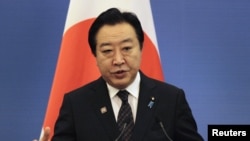
Japan's Prime Minister Yoshihiko Noda gestures in front of a Japanese national flag as he speaks at a joint news conference, May 13, 2012.
Japan's prime minister has called for the reopening of an idle nuclear plant, saying Japan cannot do without atomic energy.
At a news conference Friday, Prime Minister Yoshihiko Noda called for all operations to resume at the Ohi nuclear plant in western Japan. He said two reactors should be restarted to support people's lives, but stopped short of ordering such a move.
Mr. Noda's government is desperately seeking to gain public support to restart the reactors to avert a summer energy crunch.
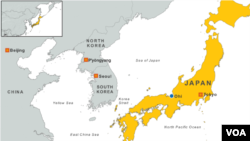
Japan's Ohi nuclear power plant
All of Japan's nuclear plants are idle following an earthquake and tsunami last year that damaged the Fukushima nuclear plant and causing a partial meltdown.
Meanwhile, hundreds of people gathered outside the Japanese prime minister's official residence in Tokyo to protest the possibility of restarting the nuclear plants.
Also Friday, the former president of Japan's Tokyo Electric Power Company, or TEPCO, appeared before a parliamentary committee and apologized for the failure. He said power officials underestimated the danger of a meltdown and had not made it a major priority.
Greenpeace Japan Executive Director Junichi Sato said in a press release that experts, not politicians, should be ruling on safety. He said that Ohi is not safe, because the necessary technical improvements have not been made.
The Fukushima nuclear plant in northern Japan was destroyed on March 11 of last year, triggering a partial meltdown and releasing potentially dangerous radiation over a wide area.
After Fukushima, scientists and energy experts have been questioning whether -- in the face of unpredictable natural disasters -- nuclear power can ever be developed economically or managed safely.
Some information for this report was provided by AP and AFP.
The Voice of America provides news and information in more than 40 languages to an estimated weekly audience of over 326 million people. Stories with the VOA News byline are the work of multiple VOA journalists and may contain information from wire service reports.