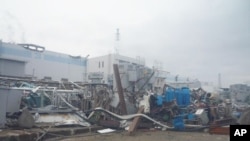
Japan and the United States have agreed to create a public-private partnership, under Tokyo's guidance, to help rebuild communities devastated by last month's magnitude 9.0 earthquake and resulting tsunami.
The announcement was made during a visit Sunday to Japan's capital by U.S. Secretary of State Hillary Clinton.
Businesses, civil society groups and public officials from the United States and Japan are to cooperate to speed the recovery of the region hit hardest by Japan's worst-ever natural disaster in modern times.
As a series of perceptible aftershocks continued to rattle Tokyo, Clinton met Sunday with Japan's foreign minister, had tea with the emperor and empress, and then held talks with Prime Minister Naoto Kan.
After a meeting with her Japanese counterpart, Clinton noted how the international community is giving back to a country that has consistently provided substantial aid when disaster has struck elsewhere.
"Japan is one of the world’s most generous nations. And the dozens of countries that have sent support in the past five weeks are honoring Japan’s legacy of caring for others," said Clinton.
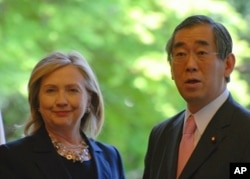
Japanese Foreign Minister Takeaki Matsumoto told the U.S. secretary of state the assistance Washington has provided, including that from American military forces stationed in the country, is greatly appreciated.
U.S. forces mobilized 20,000 personnel and nearly 200 aircraft and vessels for relief activities in Japan.
The U.S. government has also sent experts from the Nuclear Regulatory Commission and the Energy Department to help Japan deal with the emergency at the crippled Fukushima nuclear power plant.
Japan has faced criticism at home and abroad for delayed and opaque information about what has been happening at the damaged facility.
The foreign minister pledged the Japanese government would be more forthcoming about the unresolved nuclear crisis, saying Sunday, "...we would like to disclose the information about the situation, as we should, to the international community."
Prime Minister Kan, already on shaky political ground before the March 11 earthquake, is facing increasing calls to step down because of a perceived lack of leadership in response to the nuclear disaster.
The Japanese government and the Tokyo Electric Power Company are struggling to resolve the crisis at the nuclear plant. The cooling systems for the Fukushima reactors were destroyed by the tsunami. Since then the facility has leaked radiation into the air and sea, forcing the evacuation of tens of thousands of households and destroying the livelihoods of farmers and fishermen.
The utility on Sunday dampened expectations about a quick solution. The company's chairman, Tsunehisa Katsumata, told reporters it hopes to bring the situation under control in six to nine months. He explained the initial critical step, which will take about three months, is to steadily bring down the level of leaking radiation. Only after that, he said, can efforts begin to prepare the plant's four troubled reactors for a cold shutdown.