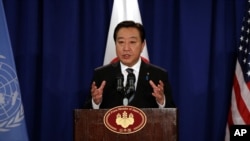
Japanese Prime Minister Yoshihiko Noda says Tokyo will not compromise on its claim to a group of uninhabited islands at the center of a heated territorial dispute with China.
Speaking at a news conference at the United Nations General Assembly on Wednesday, Noda also defended his government's recent purchase of the East China Sea islands, known as Senkaku in Japan and as Diaoyu in China.
"So far as the Senkaku Islands are concerned, they are an inherent part of our territory, in light of history and international law," he said. "It's very clear. There are no territorial issues as such, therefore there could not be any compromise that may mean any set back from this basic position. That's the point we need to clarify."
Noda said Japan's purchase of the islands from their private landowner was legal under Japanese law and meant to ensure their "stable management." But he said "China has yet to understand that."
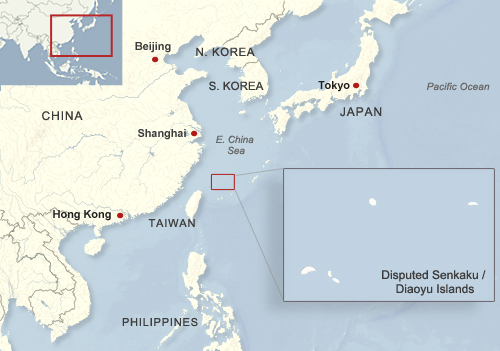
High-level talks between Tokyo and Beijing have yet to ease tensions over the dispute, which has prompted sometimes violent anti-Japan protests across China in recent days.
Noda condemned the violence, which has involved attacks on some Japanese-owned businesses and Japanese citizens living in China.
"We have conveyed clearly that violence is not to be condoned under any circumstances, and we strongly demand China to accord protection to Japanese citizens and Japanese property there," he added.
Noda made his comments after speaking to the U.N. General Assembly, where he said the dispute should be resolved peacefully, and not through force.
In responding to the speech, Chinese Foreign Ministry spokesperson Qin Gang said that "some individual country" has ignored historical facts and international laws. Qin said Japan must "face up to its history" and "cease all actions that infringe the territorial sovereignty of other countries."
Foreign ministers from both countries met Tuesday on the sidelines of the U.N. meeting in New York. But the talks failed to yield any progress, with Japanese officials describing the meeting as "severe."
There are concerns that the dispute over islands, which are surrounded by rich fishing grounds and potential energy deposits, may hurt the strong economic relationship between China and Japan, Asia's two largest economies.
Speaking at a news conference at the United Nations General Assembly on Wednesday, Noda also defended his government's recent purchase of the East China Sea islands, known as Senkaku in Japan and as Diaoyu in China.
"So far as the Senkaku Islands are concerned, they are an inherent part of our territory, in light of history and international law," he said. "It's very clear. There are no territorial issues as such, therefore there could not be any compromise that may mean any set back from this basic position. That's the point we need to clarify."
Noda said Japan's purchase of the islands from their private landowner was legal under Japanese law and meant to ensure their "stable management." But he said "China has yet to understand that."
High-level talks between Tokyo and Beijing have yet to ease tensions over the dispute, which has prompted sometimes violent anti-Japan protests across China in recent days.
Noda condemned the violence, which has involved attacks on some Japanese-owned businesses and Japanese citizens living in China.
"We have conveyed clearly that violence is not to be condoned under any circumstances, and we strongly demand China to accord protection to Japanese citizens and Japanese property there," he added.
Noda made his comments after speaking to the U.N. General Assembly, where he said the dispute should be resolved peacefully, and not through force.
In responding to the speech, Chinese Foreign Ministry spokesperson Qin Gang said that "some individual country" has ignored historical facts and international laws. Qin said Japan must "face up to its history" and "cease all actions that infringe the territorial sovereignty of other countries."
Foreign ministers from both countries met Tuesday on the sidelines of the U.N. meeting in New York. But the talks failed to yield any progress, with Japanese officials describing the meeting as "severe."
There are concerns that the dispute over islands, which are surrounded by rich fishing grounds and potential energy deposits, may hurt the strong economic relationship between China and Japan, Asia's two largest economies.
Some information for this report was provided by AP and AFP.