


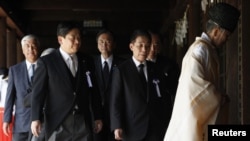
Two Japanese cabinet ministers have visited a controversial war shrine seen by many as a symbol of Tokyo's imperialist past, in a move likely to anger neighboring China and South Korea.
National Public Safety Commission Chairman Jin Matsubara and Land Minister Yuichiro Hata on Wednesday paid homage at Tokyo's Yasukuni Shrine, which honors Japan's war dead, including some convicted of war crimes.
The visit, which comes on the 67th anniversary of Japan's surrender in World War II, is the first by a cabinet minister since the Democratic Party came to power in 2009, pledging improved relations with Tokyo's Asian neighbors.
Though economic ties between Seoul and Tokyo are strong, anti-Japan sentiment is widespread in South Korea. Japan imposed harsh colonial rule on South Korea and parts of China during much of the first half of last century.
Regional tensions
Relations between South Korea and Japan worsened last week after South Korean President Lee Myung-bak made a surprise visit to a group of rocky islands claimed by both countries. The islands, known as Dokdo in Korea and Takeshima in Japan, are thought to be surrounded by potential energy deposits. Following Mr. Lee's visit, Tokyo recalled its ambassador to Seoul.
On Wednesday, President Lee said in a speech that Japan is a "close neighbor" and "friend," but said certain aspects of their mutual history is "hampering the common march toward a better tomorrow." Mr. Lee renewed his call for Japan to compensate Korean women forced into sex slavery for Japanese soldiers during World War II. Japan says compensation for the so-called "comfort women" was already covered in a 1965 treaty that normalized bilateral relations.
At a memorial in Tokyo, Japanese leaders including Prime Minister Yoshihiko Noda offered silent prayers for war victims. In his speech, Mr. Noda acknowledged that Japan regrets inflicting "significant damage on many countries, especially on people in Asian countries." On Tuesday, President Lee insisted that Japan's Emperor Akihito would have to sincerely apologize for its colonial rule if he wants to visit South Korea.
Beijing has also signaled opposition to the Japanese shrine visit. The state-controlled China Daily says the move risks "putting hard-won diplomatic relations with China in jeopardy." Japan-China relations have also been tested by competing claims to a group of uninhabited islands in the energy-rich East China Sea.
National Public Safety Commission Chairman Jin Matsubara and Land Minister Yuichiro Hata on Wednesday paid homage at Tokyo's Yasukuni Shrine, which honors Japan's war dead, including some convicted of war crimes.
The visit, which comes on the 67th anniversary of Japan's surrender in World War II, is the first by a cabinet minister since the Democratic Party came to power in 2009, pledging improved relations with Tokyo's Asian neighbors.
Though economic ties between Seoul and Tokyo are strong, anti-Japan sentiment is widespread in South Korea. Japan imposed harsh colonial rule on South Korea and parts of China during much of the first half of last century.
Regional tensions
War Shrine Facts
Facts about Tokyo's controversial Yasukuni Shrine- Shinto shrine built in 1869 to enshrine the souls of around 2.5 million war dead
- Commemorates 14 men convicted of war crimes after Japan's World War II surrender
- Seen by many Asians as symbol of Japan's brutal imperialistic era
- Has become a rallying point for some conservative Japanese lawmakers
On Wednesday, President Lee said in a speech that Japan is a "close neighbor" and "friend," but said certain aspects of their mutual history is "hampering the common march toward a better tomorrow." Mr. Lee renewed his call for Japan to compensate Korean women forced into sex slavery for Japanese soldiers during World War II. Japan says compensation for the so-called "comfort women" was already covered in a 1965 treaty that normalized bilateral relations.
At a memorial in Tokyo, Japanese leaders including Prime Minister Yoshihiko Noda offered silent prayers for war victims. In his speech, Mr. Noda acknowledged that Japan regrets inflicting "significant damage on many countries, especially on people in Asian countries." On Tuesday, President Lee insisted that Japan's Emperor Akihito would have to sincerely apologize for its colonial rule if he wants to visit South Korea.
Beijing has also signaled opposition to the Japanese shrine visit. The state-controlled China Daily says the move risks "putting hard-won diplomatic relations with China in jeopardy." Japan-China relations have also been tested by competing claims to a group of uninhabited islands in the energy-rich East China Sea.