Japan's Next PM Ramps Up Pressure on Bank of Japan
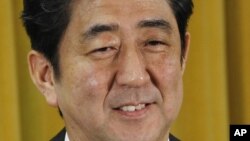
Japan's Liberal Democratic Party President Shinzo Abe smiles during a question and answer during a press conference at the party headquarters in Tokyo, December 17, 2012.
Incoming Japanese Prime Minister Shinzo Abe has renewed his pledge to pressure the Bank of Japan to ease monetary policy after leading his conservative party to a sweeping election victory.
Speaking to a packed news conference Monday, Abe said the central bank should heed the election result when it meets later this week to discuss policy. He said once he formed his cabinet on December 26, he would instruct ministers to double the Bank of Japan's inflation target.
During the campaign leading up to Sunday's landslide victory, he had called for increased public works spending and an easy monetary policy to pull Japan's once-vibrant economy from its fourth recession in the past 12 years.
Abe also vowed to improve ties with Beijing while standing firm on Japan's claim to a cluster of uninhabited islands in the East China Sea controlled by Tokyo but claimed by China and Taiwan.
The conservative leader on Monday again called the Senkaku islands "inherently Japanese territory," referring to the islands that China calls Diaoyu.
In Beijing, Chinese Foreign Ministry spokesperson Hua Chuying responded that China is highly concerned about which direction Japan will take now that the election is over, and hopes that Japan will encourage constructive and peaceful development of ties between the two countries.
Abe's Liberal Democratic Party said it won 294 seats and its coalition partner New Komeito 31 in the 480-member House of Representatives. That would secure a two-thirds' majority - enough to override the upper house, where the ruling Democratic Party of Japan is the largest single party.
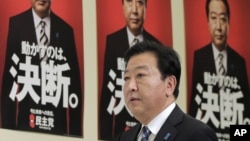
Japanese Prime Minister Yoshihiko Noda announced his resignation as the DPJ chief after losing in parliamentary election in Tokyo, December 16, 2012.
The DPJ, headed by current Prime Minister Yushihiko Noda, got only 57 seats in Sunday's elections. Noda promptly announced his resignation as party chief, acknowledging that the DPJ has not been able to meet people's expectations.
U.S. President Barack Obama congratulated Abe on his success and said he is looking forward to working closely with the new Japanese government.
The LDP, Japan's conservative nationalist party, has dominated the country's politics since the 1950s, with only a few brief periods in opposition. Abe last led the country in 2006, but he stepped down after a troubled year in office, citing health problems.
The country remains in a two-decade economic slump, and voter dissatisfaction in 2009 allowed Mr. Noda's DPJ party to wrest power from the conservatives. Since that DPJ win, critics say the party has failed to deliver on a series of promises, including vows to crack down on wasteful government spending, and promises of cash incentives to encourage young couples to start families.
The Voice of America provides news and information in more than 40 languages to an estimated weekly audience of over 326 million people. Stories with the VOA News byline are the work of multiple VOA journalists and may contain information from wire service reports.