


News / Asia

Japan's Prime Minister Survives Ouster Bid
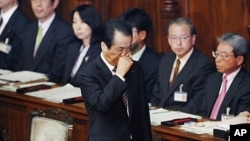
Japanese Prime Minister Naoto Kan reacts as he leaves the plenary session at the lower house, after surviving a no-confidence motion over his response to Japan's massive tsunami and ensuing nuclear crisis in Tokyo, June 2, 2011
TEXT SIZE - +

Japan’s prime minister has survived a no-confidence motion in parliament. But, Naoto Kan is offering to step down, eventually, once he feels plans to recover from history’s costliest natural disaster are on track.

The Japanese prime minister Thursday, partly under pressure from rebels in his own party, offered to resign once post-disaster reconstruction efforts are in place.

Kan told members of his Democratic Party that he desires to hand over power to a younger generation.

Japan's unprecedented disaster - a major earthquake and tsunami -  has left at least 20,000 people dead or missing.  It also triggered meltdowns of several reactors at a nuclear power plant on the country’s northeast coast, which spewed
radiation into the atmosphere and sea.

Hours after Kan made his resignation offer, Japan’s parliament rejected a no-confidence motion against his government.

The announcement of the tally of votes in the lower house shows 293 lawmakers voting against the motion, while 152 cast ballots in favor of ousting Kan.

Some of those opposing the prime minister were members of his own party.

Opposition politicians submitted the motion, saying the prime minister has failed to adequately lead Japan during this time of crisis.

Kan’s public approval rating is below 30 percent.

Political analysts suggest the prime minister may be able to stay in office for several more months.  He is Japan’s fifth prime minister in five years.

You May Like

South Africa to Host World's Biggest Telescope

South Africa competed against Australia to host the telescope, the final decision was to split the SKA between the two countries More

Report: Global Warming Could Reverse Development

World Bank study says warmer climates threaten advances and could exacerbate poverty in world’s poorest regions More

Video Inmates Fight Fires, Gain Skills for Life After Prison

In California, physically fit inmates with no history of violent crimes can train, work as firefighters while serving their time More

This forum has been closed.
Comments
     
There are no comments in this forum. Be first and add one

Featured Videos

Your JavaScript is turned off or you have an old version of Adobe's Flash Player. Get the latest Flash player.
Video

Video Human Rights Film Festival Highlights Gender, Economic Issues

Twenty new films from around the world are screening in New York this week, as part of the 24th annual Human Rights Watch Film Festival, co-presented by the Film Society of Lincoln Center and IFC Center. The issues explored range from the rights of women, gays and the disabled, to economic justice, to political murder, torture and wrongful imprisonment. VOA’s Carolyn Weaver reports from New York.