


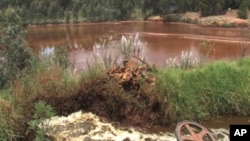
The discovery of gold was the reason for the birth and the rise of Johannesburg, long called the "City of Gold." But a century later, those same mines, where toxic water has built up in abandoned shafts and may leak into South Africa's water supply, now pose a serious threat.
"This used to be a very popular recreational lake," Mariette Liefferink said as she answered questions from a group of locals and researchers. "As a result of acidic mine waters that decanted in 2002, the Robinson Lake today is a declared radioactive dam as you can see. Its uranium level that was measured in 2002 was 40000 times natural uranium levels in fresh water.”
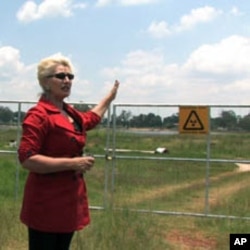
Liefferink is the chief executive of the Federation for Sustainable Environment. For years, she has been taking people around to show them contaminated mine sites, and raise the alarm bell.
"We’re going to measure, who wants the PH strip? This is a PH of 2, can you see? This is similar to lemon juice," she said. "So this is more likely to mean that nothing can live in this water."
We are in Randfontein, 45 kilometers from Johannesburg. Here, toxic waters started to leach into the ground 10 years ago. The water is orange, tainted with radioactive minerals and has a strong acidic odor.
This is the result of massive excavating in the search for gold until the 1970s when mining activities stopped here and shafts were abandoned. Also abandoned were the pumps that kept the tunnels dry. So water massed, oxidizing the minerals on the walls and creating sulfuric acid that is now drained by rainwater into the soil and underwater lakes.
Nico Jacobs' farm lies in the middle of this huge agricultural area. Around his house, cultivated fields and cattle as far as the eyes can see. His family knows the water they use is not normal.
"My little baby, she's 8 years old, she had a bath last night, and this is what the water looks like," said Jacobs. "If we start draining the water, you will see the blue marks scattered around the sides of the bath."
Nico Jacobs, a farmer in Randfontein, shows the blueish water that is coming out of his bath tub faucet, January 2012. (VOA - Emilie Iob)
The toxic water is affecting his business, saying he used to have 200 cows but now there are only 46 left. He blames the contamination.
"If things aren't gonna improve or getting resolved, I think we gonna end up with pieces of land that won't be productive, and the food chain is gonna be impacted."
The affected areas are not only in the surrounding countryside. Johannesburg itself sits on top of a gold mine and heaps of excavated soil are visual reminders of the city’s history. Even a major amusement park in the central business district, Gold Reef City, features a ride that goes through a mine shaft.
Experts say the cost of cleaning up derelict mines would be enormous and could accelerate the decline of the key mining industry in South Africa, one of the top five gold producing countries on the world.
The problem is complicated, said Anthony Turton, a scientist who specializes in water resource management.
"If we continue to ignore it, South Africa is going to continue to have investor confidence in the economy eroded. That is not good for anyone. The second thing that is going to happen is you're going continuously get a human health issue coming to the fore, and that is going to feed into the investor confidence slowly. The third thing that is going to happen, is that we're building up a level of salt in our rivers and therefore salt on our agriculture land and therefore we're going to start limiting our capacity as a nation to feed itself."
Despite this, Turton cautioned against overreaction.
"There is a lot of alarmism going on, about this acid mining drainage story. Yes, acid mine drainage is a problem, a significant problem, but certainly not going to float the streets of Johannesburg."
The government has been aware a solution was going to be needed since the mid-1990s. The problem is there was little to no regulation of the mining industry under apartheid and most mining companies who were here then deny responsibility.
Toxic waters threaten those who live in South African townships very close to the former mines, like this one located near Randfontein. (VOA - Emilie Iob)
Last year, a group of experts proposed a series of measures to purify the water. But this sustainable solution has an estimated cost of four times the budget allocated to the ministry of water for the next three years.
The government and some mining companies, like AngloGold Ashanti, are working on plans to expanding efforts to pump the toxic water and how to cover costs.