



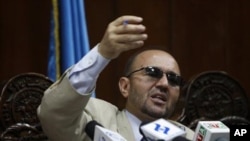
Afghanistan’s largest lender, Kabul Bank, is embroiled in a corruption scandal threatening billions of dollars in international aid. The International Monetary Fund says its support to the country depends on whether officials can fix the problems that led to the bank’s collapse and government takeover last year.
The situation got even more complicated this week. Afghanistan issued an arrest warrant for Central Bank governor Abdul Qadir Fitrat, after he fled to Washington and resigned his post.
In an interview with VOA, the former central bank chief said he feared his life was in danger from those he tried to prosecute for "stealing millions" from Kabul Bank.
Abdul Qadir Fitrat speaks with VOA's John Walker in Washington:
But the Afghan government says Fitrat is the guilty party, and was involved in massive fraud at the bank.
VOA’s Kate Woodsome spoke with Martine van Bijlert, the co-director of the Kabul-based Afghanistan Analysts Network, about the scandal, the bank’s history, and its impact on the future of Afghanistan.
Listen to the Interview:
Abdul Qadir Fitrat told VOA there’s evidence showing a complex Ponzi scheme, designed to drain millions from Kabul Bank and flow to corrupt individuals. Is this a legitimate claim?
“Well, basically, it’s clear that the Kabul Bank didn’t operate like a normal bank. The shareholders borrowed or took large amounts of money from the bank, and invested that in very shaky investments. So some of that is still there and some of that has been lost. Basically, they used it as a private investment fund, which is not the normal way of running a bank.”
Fitrat says he’s in danger for accusing the bank’s shareholders, including the brothers of the Afghan president and vice president, of corruption. Does he have a reason to be scared?
“In Afghanistan, everything’s personal. And so if you go public and you smear someone’s name, because that’s the way it’s being seen, that’s taken very personally. Basically Fitrat briefed parliament on the research and the investigation they had done, and he named the biggest borrowers in the bank, and that included the brothers of the president and the brother of the vice president.
They were not very pleased that they were presented as corrupt individuals. Whether that goes as far as really putting his life in danger, I am not so sure. But he was very much under a lot of pressure.”
He was also under a lot of pressure from the international community to clean up this bank.
“It was very important for the international community. It actually became the main point in the negotiations between the IMF [International Monetary Fund] and the Afghan government. And the IMF is still not satisfied with how much the Afghan government has moved on this case. It’s withholding an agreement, which is making other donors withhold funds, so it’s really a big deal.
The U.S. is very closely involved in this sector. They’ve been the force pushing for resolving the banking crisis. They pushed Fitrat very hard to go public in parliament. They really want this out in the open and sorted out. It’s just very complicated because there are possibilities that a very large part of the political class is involved in this somehow. There’s been a report that said USAID, that’s been supporting the banking sector, should have been much more proactive. It’s become a very complex problem wherein actually everybody who’s involved has some blame.”
Kabul Bank handles about 80 percent of the government payroll, including salaries for policemen and teachers, so it’s really a part of sort of the running of the government. How stable is it, and what’s the potential fallout from this scandal?
“Well, what happened is that they split the bank into sort of a good running part, which is the part that handles the salaries at the moment, and then the part which holds all the loans which should never have been given. And that part is in receivership and they’re trying to get as much back from those loans as they can.
So, in principle, the good part of the bank should be stable at the moment. It’s going to probably be sold at some point, but for the moment it’s being run under the Central Bank and the Ministry of Finance. But in general, the banking system in Afghanistan is very shaky. It’s not been well regulated. That’s also why this could have happened. And it’s just not very well established yet, so there is a bit of nervousness that if any other banks get into trouble or if there are any other big media issues, it could really shake the Afghan economy.”
The bank had an unusual start. It was founded in 2004 by an international poker player, Sherkhan Farnood.
“It was founded by someone who didn’t have experience in the banking center, but he did have experience in the Hawala sector, in the informal money transporting sector. This is part of the lack of regulation within the banking system that people with no prior experience could set up large banks like that and play such a central role in the Afghan economy.”
Afghanistan has issued an arrest warrant for Fitrat, who has U.S. residency. How is this going to affect the already strained U.S.-Afghan relations?
“It’s going to be very interesting to watch who’s going to be the new head of the Central Bank. Because it’s such an important issue for the United States, they will find it very important that it’s someone they can work with; that it’s someone who’s seen as professional and proactive and who will want to clean up the banking sector. There has been sort of a history of appointing people to spite the U.S. or the international community, or to annoy them.
In the negotiations about the IMF agreement, the Minister of Finance has come out saying, ‘I’m sorry I’ve done everything I’ve needed to do. They’re still not happy, it’s a waste of my time.’ So that could become very contentious. On the issue of Fitrat and his extradition, I think the U.S. is going to be looking very carefully at what the allegations are and how much they may or may not be true. There could be truth in them, it could also be a form of retaliation. I’d be surprised if the U.S. extradites him.”