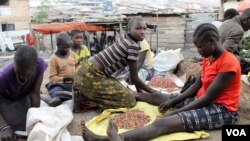
Karimojong children clean beans to make money to feed their families, Kampala, Uganda, Aug. 23, 2012 (Hilary Heuler/VOA).
KAMPALA — The streets of Kampala are teeming with children: Begging at intersections, sleeping in muddy slums and slipping down the maze-like alleys of the market, nearly all come from Karamoja, an impoverished region in northeastern Uganda.
Here to make enough money to feed their families, although some arrive with parents or older relatives, many come alone.
Twelve-year-old Mary Chipa is one of them. Driven by hunger, she set off for the Ugandan capital two weeks ago with her 10-year-old cousin Issa, the two girls squeezed into the crowded aisle of a bus.
Each paying 20 cents a night for a spot on the floor of a slum hovel, they spend their days “sweeping beans” — picking dirt from beans that fall to the ground of Owino market, one of East Africa’s largest — for which they are paid by the cup, earning about one dollar a day.
Mary says life in Kampala is hard. People beat her in the market and she has to be careful not to be caught by police. She misses her family and wants to go home, she says, but first has to make enough money to get there.
Over the years, Prossy Opio, a community leader in the slum, has seen hundreds of young Karimojong come and go.
For them, she says, life is grueling.
“They go on the road to beg money — others, they sweep beans,” she says. “The girls — if somebody wants a house girl — they can go and work for a month. In the slum area here, we just sleep in the same house… you can [fit] 30 people, 40 people.”
Children who come to Kampala alone have to be old enough to communicate and handle money, she says, but little else is required, and many of them are very young indeed, some starting as young as seven years of age.
“[A seven year old], she can talk, she can sweep the beans, she knows that this is 100 shillings, this is 10,000, this is 5,000,” says Opio. “They can understand this is beans, this is maize. So those who come alone here are mostly seven and above.”
Arrival, detention, return
Karimojong boys traditionally herd cattle, but with livestock dwindling, children go to cities to work or beg, Aug. 27, 2012 (Hilary Heuler/VOA).
Kampala authorities have been cracking down on these young migrants, rounding them up, putting them in detention centers and sending them back to Karamoja, as part of a vaguely defined law-enforcement strategy to get beggars off the streets. Opio says it’s shortsighted and futile to send the children home.
“Nothing is there, that’s why you see them back here in Kampala,” she says. “The problem is [that] government is not yet ready to re-settle them.”
According to one resident of the southern Karamoja village of Lopei, environmental and economic changes affecting the region’s traditionally pastoral lifestyle — men and young boys herding cattle and goats from one watering hole to the next — are exactly what drive children to the capital in the first place.
"Now that there are fewer cows to look after, people try to put their children in school,” she says, explaining that livestock has dwindled dramatically in recent years. “But when they don’t have enough money for school fees, they go to the cities to beg.”
Picking up the pieces
For Pierangela Cantini, Child Protection Program Coordinator for the Institute for International Cooperation and Development (CND), an Italy-based NGO, getting Karimojong youth to open up about personal experiences in the cities is an uphill battle.
“They don’t tell you what they went through here,” she says. “They don’t tell you that someone raped them only because they wanted 300 shillings to sleep. They don’t tell you that they were slapped by someone who was just passing, or maybe they didn’t eat, or they ate intestine for two weeks because there was nothing else.”
Their unwillingness to speak openly about urban hardships means that Cantini’s group can only do so much. Their programs include counseling and medical support for the young returnees, but much of their effort goes into tracing the children’s families and reintegrating them back into their communities.
Meanwhile, back in villages like Lopei, all Karimojong elders can do is hope for the best.
One woman says she prays for the children who leave — even if many are sent by their parents or depart with their consent — but that she would not complain if poverty drove her own children to the cities.