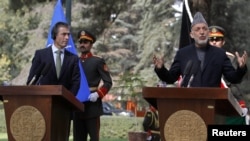
President Hamid Karzai says Afghanistan's police and military forces are ready to take full responsibility for security if the U.S.-led coalition decides to pull out of the country early.
Karzai made his comments Thursday at a joint news conference in Kabul alongside NATO Secretary-General Anders Fogh Rasmussen.
The 11-year mission in Afghanistan is increasingly unpopular among NATO member nations, and there have been calls to put in place an accelerated draw-down plan to completely hand over security to Afghan forces before the end of 2014.
But Rasmussen told reporters, "the timeline remains unchanged" and that "we are all committed to seeing our combat mission through by the end of 2014."
Prior to the press briefing, the NATO secretary-general told VOA's Afghan Service that he is confident Afghan security forces will be able to take full responsibility by the planned deadline.
He also said NATO and its partner countries will remain in Afghanistan on a training mission beyond 2014. Later in the press conference, he explained that while it is NATO's goal for Afghanistan to stand on its own feet, the country would not stand alone.
Currently NATO has some 100,000 troops on its international force in Afghanistan to support Karzai's administration as the nation grapples with a Taliban-led insurgency.
NATO Secretary-General Rasmussen reaffirmed Afghan forces security capabilities, telling VOA that "75 percent of the Afghan population lives in areas where Afghan security forces have taken the lead responsibility." He noted that there has also been a "decline in the number of enemy-initiated attacks in areas that have been handed over to Afghan forces."
When asked about the recent string of insider attacks in which Afghan forces or insurgents dressed in military uniforms turned their guns on NATO forces, Rasmussen said a number of measures have been taken to prevent such attacks.
The NATO chief told VOA that in cooperation with Afghan authorities, the coalition has "strengthened" vetting and recruitment procedures and counter-intelligence measures. He said cultural awareness courses have also been introduced for both Afghan and international forces. More than 50 coalition troops have been killed in such attacks so far this year.
Karzai made his comments Thursday at a joint news conference in Kabul alongside NATO Secretary-General Anders Fogh Rasmussen.
The 11-year mission in Afghanistan is increasingly unpopular among NATO member nations, and there have been calls to put in place an accelerated draw-down plan to completely hand over security to Afghan forces before the end of 2014.
But Rasmussen told reporters, "the timeline remains unchanged" and that "we are all committed to seeing our combat mission through by the end of 2014."
Prior to the press briefing, the NATO secretary-general told VOA's Afghan Service that he is confident Afghan security forces will be able to take full responsibility by the planned deadline.
He also said NATO and its partner countries will remain in Afghanistan on a training mission beyond 2014. Later in the press conference, he explained that while it is NATO's goal for Afghanistan to stand on its own feet, the country would not stand alone.
Currently NATO has some 100,000 troops on its international force in Afghanistan to support Karzai's administration as the nation grapples with a Taliban-led insurgency.
NATO Secretary-General Rasmussen reaffirmed Afghan forces security capabilities, telling VOA that "75 percent of the Afghan population lives in areas where Afghan security forces have taken the lead responsibility." He noted that there has also been a "decline in the number of enemy-initiated attacks in areas that have been handed over to Afghan forces."
When asked about the recent string of insider attacks in which Afghan forces or insurgents dressed in military uniforms turned their guns on NATO forces, Rasmussen said a number of measures have been taken to prevent such attacks.
The NATO chief told VOA that in cooperation with Afghan authorities, the coalition has "strengthened" vetting and recruitment procedures and counter-intelligence measures. He said cultural awareness courses have also been introduced for both Afghan and international forces. More than 50 coalition troops have been killed in such attacks so far this year.
Some information for this report was provided by AP and Reuters.