



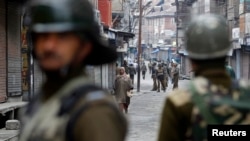
Indian authorities have lifted a week-long curfew across Indian-controlled Kashmir.
Officials lifted the ban Saturday.
Some Kashmiris found stores and businesses closed Saturday because a general strike was called by political and religious groups.
The curfew was imposed last Saturday following the hanging in New Delhi of a Kashmiri man convicted for his role in the 2001 attack on India's parliament.
Many in Kashmir believe Afzal Guru was not given a fair trial.
Protests broke out in Guru's hometown, Sopore, after his execution, even though authorities had dispatched thousands of security forces across the Kashmir Valley to clamp down on possible demonstrations.
Officials lifted the ban Saturday.
Some Kashmiris found stores and businesses closed Saturday because a general strike was called by political and religious groups.
The curfew was imposed last Saturday following the hanging in New Delhi of a Kashmiri man convicted for his role in the 2001 attack on India's parliament.
Many in Kashmir believe Afzal Guru was not given a fair trial.
Protests broke out in Guru's hometown, Sopore, after his execution, even though authorities had dispatched thousands of security forces across the Kashmir Valley to clamp down on possible demonstrations.