



The ninth-largest country in the world, Kazakhstan holds enormous reserves of oil and gas, and is the world's ninth-largest producer of uranium. Behind its booming economy, however, a bigger problem lurks on the political horizon.
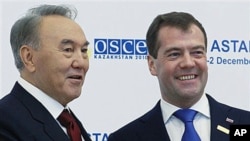
In a modern capital on the Central Asian steppe, Kazakh President Nursultan Nazarbayev welcomed world leaders to a northern hemisphere security summit Tuesday, saying: "We have created a democracy in a part of the world where it has never existed before."
Analysts point out that the creation of democracy is debatable. But what President Nazabayev has created is a booming middle class economy in the heart of Central Asia.
Kazakhstan's turbocharged economy fuels 60 percent of Central Asia's economic activity, despite the fact it only accounts for one quarter the region's population.
In the past decade, Kazakhstan's per-capita income increased 10 times, leaving Central Asian neighbors far behind and approaching levels seen in Eastern Europe.
After investing $100 billion in energy development during the past 15 years, Kazakhstan now wants to match that amount during this decade.
Aiming to double oil production in a decade, Kazakhstan is on track to join the exclusive club of the world's top 10 oil-producing countries.
But Mr. Nazarbayev, who has presided over Kazakhstan since 1989, turned 70 in September.
In Almaty, the country's commercial capital, political scientist Dosym Satpayev voices a big question on the minds of investors.
"For Kazakhstan, one of the main questions, what will happen after the death of President Nazarbayev? Because, unfortunately, all our political system, all our economical system, connected with only one person, this is the person of President Nazarbayev," Satpayev said. "All our elite groups around president Nazarbayev, they are going to fight for power."
In May, Kazakhstan's parliament overwhelmingly approved legislation granting Nazarbayev status of 'National Leader.'
Free of term limits and bolstered by high approval ratings, he agreed last month to run Kazakhstan through 2020. Faced with ruling Central Asia's dominant nation through the age of 80, though, he did ask one supporter for an 'elixir' of youth.
In this patriarchal society, Mr. Nazarbayev has not publicly acknowledged a male heir. He also has not shown interest in the power sharing path of Russian leader, Vladimir Putin. Three years ago, Mr. Putin decided to step partially out of the limelight to allow protégé Dmitri Medvedev to serve a term as president.
Kazakh opposition activist Aidos Sarym said that there is no successor in sight.
Without adopting the Putin model, Mr. Nazarbayev perhaps is boxed into ruling the nation until the end of his biological days.
Sarym and other opposition activists say there is little democracy in Kazakhstan. Every seat in parliament is occupied by members of the president's ruling coalition. The government tightly controls the press and the elections. For years, Mr. Nazarbayev has appointed all major officials, down to judges and electoral officials at the district level.
Opposition activist Sarym sees little of the kind of democracy the government promoted prior to this week's Organization for Security and Co-Operation in Europe summit in Astana. Sarym forecasts Kazakh authoritarianism is fated to stagnate the way the Soviet Union did under the later years of Leonid Brezhnev.
With the country's bounding economy - and without access to the mass media - Kazakhstan's opposition remains marginalized.
A human-rights leader is serving a four-year jail sentence in a remote jail for a traffic accident. A labor leader was convicted recently on drug-possession charges. Union members charge police planted the drugs.
In late October, Vladimir Kozlov, an opposition figure, announced that he was running for president. A nationalist group broke into the press conference and pelted Kozlov with eggs and water bottles. The next day, Almaty tax authorities announced that they were launching a tax investigation of the opposition candidate for president.