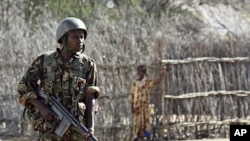



Kenya is calling for more support from the Arab world to help secure Somalia as Kenyan troops continue their pursuit of al-Shabab militants in the country. And the Kenyan military says it has shifted its tactics in the fight to help make way for humanitarian assistance.
Kenyan Foreign Ministry Assistant Director Lindsay Kiptiness told reporters in Nairobi Saturday that Kenya is turning to its Muslim partners for help in Somalia.
“As we speak now, the minister is somewhere in the Middle East to seek support from the Islamic world, which we consider to be very important," Kiptiness said. "We are working on strategies to ensure that we have the support of the Arab League as well as other Muslim nations that have given support to the TFG before, like Turkey and Iran.”
The Kenyan military says it is working with forces from Somalia's Transitional Federal Government, or TFG, to eliminate the al-Qaida-linked militant group al-Shabab in areas near the Kenyan border.
Kenya launched the military operation on its own in mid-October in what it deemed an act of self-defense, following several cross-border attacks blamed on Somali militants.
Seeking outside help
But, it has in recent weeks been seeking more support from the international community.
Kiptiness also said Kenya would be going to the United Nations to seek an expansion of the mandate of the African Union peacekeeping mission, known as AMISOM.
“We are also seeking support from the United Nations Security Council on the possibility of enhancing the operations of AMISOM to cover the entire Somalia, not only Mogadishu.”
Kenyan officials have previously said they would ask AMISOM and TFG forces to help maintain the peace in southern Somalia when Kenyan troops eventually withdrawal.
Shift in tactics
The Kenyan military says it has shifted tactics in the fight against al-Shabab. After weeks of aerial bombardments, the military says al-Shabab has now splintered into smaller factions, and so Kenyan forces have also started working on a smaller scale.
Colonel Cyrus Oguna, an information officer in the Kenyan Armed Forces, says the mission also now includes a humanitarian element.
“They're basically dealing with two major issues here: one is pacification, moving from door-to-door trying to clear al-Shabab remnants that might have sneaked behind or even mingled with the local people and that is really tedious and time-consuming. Plus, of course, trying to help the provision of security for NGOs to provide humanitarian assistance. There are various NGOs that are on the Kenyan side that could not be allowed to go in when al-Shabab was in control.”
Colonel Oguna said the new strategy explains the recent lull in military operations.
In the latest incident, Oguna said TFG forces engaged al-Shabab militants suspected of killing four Somali civilians in an ambush on a car transporting khat - a leafy, marijuana-type plant that is chewed like tobacco. Oguna said four al-Shabab fighters were killed and two TFG soldiers wounded in the fighting.
The Kenyan military says hundreds of al-Shabab fighters have been killed or wounded since the military incursion began, while five Kenyan soldiers have died.
Kenya Asks Arab World for Support in Somalia
- By Gabe Joselow