



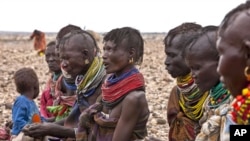
In central Kenya, food is rotting while at least 3.5 million Kenyans are going hungry mostly in the arid and semi-arid north.
The reasons for this are many: poor roads, limited transportation and storage facilities.
Farmers are now calling on the Kenyan government to step in to buy and get the food to those suffering from the impact of the Horn of Africa’s worst drought in more than 50 years.
In the midst of a food crisis in parts of Kenya due to drought, farmers cannot even give away what they grow in Kinangop Constituency - about a 90 minute drive from Nairobi.
In the lush, 1,400-square-kilometer constituency in the Rift Valley, farmers say bad roads and lack of transport make it difficult for them to get their produce to the market. And they complain about a big drop in food prices.
During a recent trip to the area, VOA was able to purchase 30 cabbages - an entire trunk full - for a total of $1.50.
But what really bothers farmer Nahashon Gitau is that he wastes at least one-quarter of his harvest during the region’s worst drought in more than half a century.
“It is for the government to make some arrangements - perhaps even give transport. Then, they can buy it at a good price, then give it to those people instead of asking for food from overseas, which is very bad," said Gitau. "When we are throwing away food, they are asking for food from overseas.”
He believes if the government were to offer a fair price for his produce, his almost three hectare farm could contribute a lot to feeding millions of hungry Kenyans impacted by the worst drought in a half century.
“From my farm? I would perhaps sell every season say, 100 bags of potatoes, and perhaps 10,000 heads of cabbages, say three times in a year, I can manage that product," Gitau stated. "And I’ve got some other farmers who can do even better than me.”
Kinangop District officer Peninnih Dzombo tells VOA why local governments have not made it a priority to act.
“We’ve not really had a forum to voice that out. In our department, in most cases we usually work through reports and all that. So it depends on who will read the report," noted Dzombo. "But we have not made the effort to have it like a priority that we want A, B, C addressed.”
She says her office does not receive enough funds from the central government to pave roads and take other measures to improve farmers’ access to markets.
The Kenyan government office in charge of disaster relief, the Ministry of State for Special Programs, did not respond to VOA's repeated requests for an interview on the situation.
But the Kinangop Constituency highlights long-running inefficiencies in food distribution and agricultural markets within Kenya.
Scholars agree widely that, with proper systems in place, Kenya does have the capacity to feed itself, even during times of drought.
Instead, foreign food aid and food imports continue to pour in. Economists say food imports reduce local food prices, decrease the productivity of Kenyan farmers, and increase dependency among the people.