News / Africa

Kenyan Farmers Invest in Own Farms With Help of FAO

Investing in drought tolerant crops avoids future food insecurities

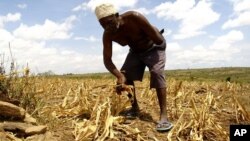
A farmer gathers arid corn crops on his farm in Kwale, Kenya (File Photo).
TEXT SIZE - +
Kim Lewis

Kenyan farmers are looking forward to better crops after this year’s rainy season, thanks to help from the food and agriculture organization, the FAO.

The organization is helping farmers prepare their fields to conserve rain water for crop use and to prevent soils from being washed away.  This will help prevent food security crises in the future.

Farmers in Kenya have been affected by drought for the past three-four seasons.
Dr. Paul Omanga, crop production officer for the FAO in Nairobi, said one of the things they are encouraging farmers to do is plant drought tolerant crops.

“The drought tolerant crops are those crops that can tolerate drought.  They can grow with minimal rainfall, minimal moisture.  There are crops such as sorghum, cowpeas, green gram, pigeon peas, millet.  These crops are usually grown by farmers in dry land areas,” said Omanga.

He said sometimes during droughts farmers do not have seeds, so the FAO along with the help of development partners buy seeds and distribute them to the most vulnerable farmers.
In addition, Omanga said the FAO is also working with farmers to do soil and water conservation interventions.

“The FAO facilitates the farmers through cash for work to dig terraces on their own farms in groups of 20-30 households, and they work assisting each other in digging these terraces,” said Omanga.

The terraces conserve the soil and prevent soil erosion, as well as conserve rainfall for crop use.

“You find in most vulnerable households the members of the families cannot do this because at the time they are supposed to be conserving their farms, they go to work for  better off households to help meet their household needs,” explained Omanga.

Omanga said by having families work in groups they are better able to do soil and water conservation on their on farms, thereby improving their crop production at the end of the season.

You May Like

India, China Pledge to Overcome Border Tensions

Indian prime minister and Chinese premier attempt to move past tense standoff in the Himalayas during Delhi talks More

Burmese President Opens US Visit with VOA Town Hall Meeting

Ahead of his meeting with President Obama Monday, Thein Sein answered questions on human rights and economic development in his country More

Video Washington Week: Focus on Burma, US Government Scandals

President Thein Sein visits the White House on Monday, Congressional probes of multiple scandals are continuing More

This forum has been closed.
Comments
     
There are no comments in this forum. Be first and add one

Featured Videos

Your JavaScript is turned off or you have an old version of Adobe's Flash Player. Get the latest Flash player.
Video

Video Boston Bomber Spent 6 Months in Russia’s Most Violent Republic

The news of the Boston Marathon bombings circled the globe, and resonated here in Dagestan, a majority Muslim republic in Russia, on the shores of the Caspian Sea. Last year, Tamerlan Tsarnaev, the older of two brothers suspected of the bombings and a long-time Boston resident, returned to Dagestan, where he had lived for a year during his youth. Dagestan was the land of his maternal ancestors. But in the last two years, this republic of 3 million people has gained notoriety as the region with the highest level of political and religious violence in all of Russia. VOA's James Brooke reports from Makhachkala, Russia.