



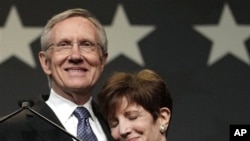
The U.S. Democratic Party managed to hold onto control of the U.S. Senate, but the margin of its slim majority has yet to be decided with three key Senate races still too close to call.
Democrats are assured of winning at least 51 Senate seats in Tuesday's election, while Republicans have at least 46 as of early Wednesday morning.
Still undecided
In Colorado, Republican Ken Buck led Democrat Michael Bennet by fewer than 10,000 votes. And in the western state of Washington, incumbent Democratic Senator Patty Murray leads Republican Dino Rossi, a businessman who has twice lost the state governor's race, by about 14,000 votes.
Officials in both states say it could be days before a winner is declared. They also say the vote differentials are so small that the final result could trigger automatic recounts.
Voters in Alaska are also waiting for a winner in that state's Senate contest.
Tea Party-backed Joe Miller, won the Republican nomination, and faced off against incumbent Lisa Murkowski, a Republican who ran as a write-in candidate. Democrat Scott McAdams also ran.
U.S. news organizations project Alaska's Senate race will go to one of the two Republican candidates.
Anti-Obama
U.S. approval ratings for President Barack Obama have slipped and frustration over the U.S. economy and anti-incumbent sentiment has risen, making for some hotly contested races in Tuesday's midterm elections.
One of the most closely watched races took place in the western state of Nevada. Senate Majority Leader Harry Reid, a Democrat, fended off a tough challenge from conservative Republican Sharron Angle, a Tea Party favorite. Reid was elected to the Senate in 1986 and has seen his popularity plummet as the state faces some of the worst foreclosure and jobless rates in the country.
In the state of Kentucky, Tea Party favorite Rand Paul won the Senate race against state Attorney General Jack Conway, a Democrat. Paul became the Republican nominee in a surprise upset over Kentucky's Secretary of State, Trey Grayson.
In a three-way contest in Florida, former state lawmaker and Tea Party favorite Marco Rubio defeated Democratic candidate Kendrick Meek and Governor Charlie Crist, who ran for the Senate seat as an independent after losing the Republican nomination to Rubio.
Controversial candidate loses
In Delaware, Democrat Chris Coons defeated conservative activist and political novice Christine O'Donnell to win the Senate seat once held by Vice President Joe Biden. O'Donnell, a Tea Party-backed candidate, generated controversy after winning the Republican nomination in an upset over moderate veteran U.S. Representative Mike Castle.
In Pennsylvania, conservative Republican Pat Toomey won his bid for the Senate seat held by Democrat Arlen Specter. Specter quit the Republican Party in 2009 and became a Democrat, only to lose the Democratic primary this year to Representative Joe Sestak.
In yet another contentious race, California Democratic Senator Barbara Boxer held on to her seat, deflecting a strong challenge from Republican Carly Fiorina -- a former chief executive officer of the Hewlett-Packard company.
House of Representatives |
Note: Vertical line represents number needed for majority (218).
Senate |
Note: Vertical line represents number needed for majority (51).