



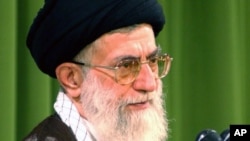
Iran's supreme leader says his country is not seeking nuclear weapons, but if it wanted to, no country could stop it from doing so.
Ayatollah Ali Khamenei, who has the final say in all state matters in Iran, said Saturday that Iran supports the elimination of nuclear weapons.
Khamenei said in comments posted on his website that, "We believe that nuclear weapons must be eliminated. We don't want atomic weapons." But he went on to say that if Iran intended to have such weapons, no country could stand in its way.
Iranian officials have said that a religious decree by Khamenei banning nuclear weapons is binding on the Islamic Republic.
The West suspects Iran is developing a nuclear weapons capability under the guise of a civilian atomic energy program, a charge Iran rejects. Tehran says its nuclear program is only for peaceful purposes.
The U.S. and some other countries are due to meet Iranian officials in Kazakhstan later this month to discuss Tehran's nuclear program. The U.N. has placed sanctions on Iran.
Ayatollah Ali Khamenei, who has the final say in all state matters in Iran, said Saturday that Iran supports the elimination of nuclear weapons.
Khamenei said in comments posted on his website that, "We believe that nuclear weapons must be eliminated. We don't want atomic weapons." But he went on to say that if Iran intended to have such weapons, no country could stand in its way.
Iranian officials have said that a religious decree by Khamenei banning nuclear weapons is binding on the Islamic Republic.
The West suspects Iran is developing a nuclear weapons capability under the guise of a civilian atomic energy program, a charge Iran rejects. Tehran says its nuclear program is only for peaceful purposes.
The U.S. and some other countries are due to meet Iranian officials in Kazakhstan later this month to discuss Tehran's nuclear program. The U.N. has placed sanctions on Iran.
Some information for this report was provided by AP and Reuters.