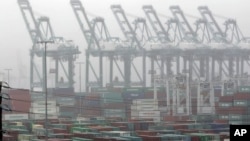
Negotiations to end a strike at the biggest cargo port complex in the United States are continuing Tuesday, as the dispute enters its second week.
Unionized clerical workers at the Los Angeles and Long Beach ports in California walked off the job last Tuesday, claiming that shippers who operate out of the twin ports want to outsource jobs overseas. The group representing the shippers and terminal operators say they merely want the right to hire the people they need.
Port of Los Angeles spokesman Phillip Sanfield told VOA that port officials hope the two sides can reach an agreement on Tuesday. He says the strike has shut down seven of eight Los Angeles shipping terminals.
"It's essentially shut down the port of L.A., which is the nation's largest container port for our container operations," he said. "And next door at the port of Long Beach, three of their six container terminals are operating, so this has had a huge impact on the importing and exporting of goods through the Western U.S."
About 40 percent of all goods shipped to the U.S. come through Los Angeles and Long Beach, averaging $1 billion in trade a day.
Sanfield says the two ports' top imports include furniture and automobile parts, as well as electronics, clothing, shoes and toys - items that make up a large part of retailers' holiday shopping sales.
Sanfield says most of the cargo comes through Asia, with China and Hong Kong as the Los Angeles port's primary trading partners, followed by Japan, South Korea, Taiwan and Vietnam. He says a smaller percentage of goods is routed through India, Central America and Northern Europe.
The now eight-day strike has idled some ships off the California coast, while forcing others to divert their cargo to other ports in California, Mexico and Panama.
The 800 clerical workers on strike have been joined by about 10,000 unionized dockworkers who have refused to cross the picket lines to load and unload cargo. Hundreds of independent truck drivers who haul goods to and from the ports have also been idled by the dispute.
Los Angeles Mayor Antonio Villaraigosa has demanded the two sides bring in a mediator and work nonstop until the dispute is settled.
The National Retail Federation, meanwhile, is urging President Barack Obama to intervene, warning that a prolonged strike could harm the still-fragile U.S. economy.
Unionized clerical workers at the Los Angeles and Long Beach ports in California walked off the job last Tuesday, claiming that shippers who operate out of the twin ports want to outsource jobs overseas. The group representing the shippers and terminal operators say they merely want the right to hire the people they need.
Port of Los Angeles spokesman Phillip Sanfield told VOA that port officials hope the two sides can reach an agreement on Tuesday. He says the strike has shut down seven of eight Los Angeles shipping terminals.
"It's essentially shut down the port of L.A., which is the nation's largest container port for our container operations," he said. "And next door at the port of Long Beach, three of their six container terminals are operating, so this has had a huge impact on the importing and exporting of goods through the Western U.S."
About 40 percent of all goods shipped to the U.S. come through Los Angeles and Long Beach, averaging $1 billion in trade a day.
Sanfield says the two ports' top imports include furniture and automobile parts, as well as electronics, clothing, shoes and toys - items that make up a large part of retailers' holiday shopping sales.
Sanfield says most of the cargo comes through Asia, with China and Hong Kong as the Los Angeles port's primary trading partners, followed by Japan, South Korea, Taiwan and Vietnam. He says a smaller percentage of goods is routed through India, Central America and Northern Europe.
The now eight-day strike has idled some ships off the California coast, while forcing others to divert their cargo to other ports in California, Mexico and Panama.
The 800 clerical workers on strike have been joined by about 10,000 unionized dockworkers who have refused to cross the picket lines to load and unload cargo. Hundreds of independent truck drivers who haul goods to and from the ports have also been idled by the dispute.
Los Angeles Mayor Antonio Villaraigosa has demanded the two sides bring in a mediator and work nonstop until the dispute is settled.
The National Retail Federation, meanwhile, is urging President Barack Obama to intervene, warning that a prolonged strike could harm the still-fragile U.S. economy.