


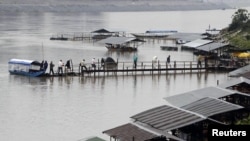
BANGKOK — Thai opponents of a hydropower dam planned for the Mekong River in Laos are taking their case to court, but not in communist Laos. In a bid to halt the project’s future they have filed a lawsuit against Thai energy authorities to try to cancel an agreement to buy most of the electricity produced by the dam.
The lawsuit argues the agreements are unconstitutional and illegal because they did not involve public consultation with villagers or downstream countries. Villagers hope that without the power purchase agreement, the $3.6 billion dam project will not be able to go ahead.
Pianporn Deetes, campaign manager with International Rivers, an environmental activist group involved with the lawsuit, says villagers already complain of adverse affects from upstream dams in China. Deetes said they worry about further damage if dams are built on the lower Mekong.
“Villagers have experienced negative impacts such as the change of ecosystem, unusual water fluctuations, flash flooding or flash drought, that is not natural any more," Deetes explained. "And, this adversely affected fish migration patterns.”
The Mekong River Basin is the biggest inland fishery in the world. About 60 million people depend on the river for their livelihoods.
Downstream countries Cambodia and Vietnam also oppose the project out of concern for the effect on fish stocks.
But, impoverished Laos wants to build the Xayaburi dam, and several others, as part of plans to become the “battery” of Southeast Asia.
The lawsuit, though supported with 1,000 signatures, is likely to face strong opposition from Thailand’s energy authorities as well as Thai companies that are heavily invested in the project.
Nonethless, Pianporn says they are optimistic they can win the case and hope to set a precedent for future cross-border projects.
“There are lots of Thai companies investing in neighboring countries, particularly Laos, Cambodia, and Burma, without any standards," Pianporn said. "They do not have to follow with Thai laws. We would like to see that this lawsuit would set a new standard with Thai overseas investment that at least they have to follow or respect the law in their home country.”
Laos suspended the Xayaburi dam project after strong opposition from Cambodia and Vietnam.
But, environmental groups point out project-related construction and deal-making has continued, indicating that Laos plans to go ahead with the dam regardless.
The lawsuit argues the agreements are unconstitutional and illegal because they did not involve public consultation with villagers or downstream countries. Villagers hope that without the power purchase agreement, the $3.6 billion dam project will not be able to go ahead.
Pianporn Deetes, campaign manager with International Rivers, an environmental activist group involved with the lawsuit, says villagers already complain of adverse affects from upstream dams in China. Deetes said they worry about further damage if dams are built on the lower Mekong.
“Villagers have experienced negative impacts such as the change of ecosystem, unusual water fluctuations, flash flooding or flash drought, that is not natural any more," Deetes explained. "And, this adversely affected fish migration patterns.”
The Mekong River Basin is the biggest inland fishery in the world. About 60 million people depend on the river for their livelihoods.
Downstream countries Cambodia and Vietnam also oppose the project out of concern for the effect on fish stocks.
But, impoverished Laos wants to build the Xayaburi dam, and several others, as part of plans to become the “battery” of Southeast Asia.
The lawsuit, though supported with 1,000 signatures, is likely to face strong opposition from Thailand’s energy authorities as well as Thai companies that are heavily invested in the project.
Nonethless, Pianporn says they are optimistic they can win the case and hope to set a precedent for future cross-border projects.
“There are lots of Thai companies investing in neighboring countries, particularly Laos, Cambodia, and Burma, without any standards," Pianporn said. "They do not have to follow with Thai laws. We would like to see that this lawsuit would set a new standard with Thai overseas investment that at least they have to follow or respect the law in their home country.”
Laos suspended the Xayaburi dam project after strong opposition from Cambodia and Vietnam.
But, environmental groups point out project-related construction and deal-making has continued, indicating that Laos plans to go ahead with the dam regardless.