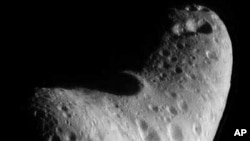



The U.S. space agency, NASA, says an asteroid measuring 400 meters in diameter will pass the Earth within the orbit of the moon in November, giving scientists their best opportunity so far to closely observe a space rock this large.
Asteroid 2005 YU55 is classified as a potentially hazardous Near-Earth Object, but NASA says it poses no threat for at least the next 100 years. Astronomers say the asteroid will fly past the Earth November 8 within a distance of only 326,400 kilometers. That is 15 percent closer to the planet than the moon.
NASA is eagerly preparing for the asteroid’s approach with plans for a wide variety of radar, visual and infrared observations, including using the radar capabilities at its Deep Space Network facility in Goldstone, California, and the huge Arecibo dish in Puerto Rico.
The space agency says the next known close fly-by to rival asteroid 2005 YU55 will not occur for 17 years, in 2028, when a different asteroid will pass within 230,400 kilometers of the Earth.
Astronomers working on the Spacewatch project at the University of Arizona’s Tucson Lunar and Planetary Laboratory discovered asteroid 2005 YU55 in December 2005.
Asteroids are made of materials, such as rock, ice and metals, that were left over after the planets formed 4.6 billion years ago. Besides looking for ways of protecting the Earth from deadly collisions, scientists study asteroids to learn more about the origins and diversity of the planets in the solar system, as well as the origin of life. Human spaceflight one day might include visiting asteroids or even mining them for valuable metals and other resources.
The average distance from the Earth to the moon is about 384,000 kilometers. The actual distance at any particular time varies because the Moon travels in an elliptical orbit around the sun. The moon’s distance from the Earth can range from a perigee (closest point) of 363,100 kilometers to an apogee (farthest point) of 405,700 kilometers.
Large Asteroid to Pass Near Earth in November