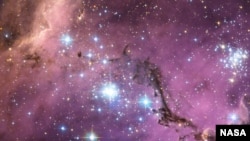
An international team of astronomers has discovered that one of our closest galactic neighbors is about 40,000 light years closer than previously thought.
The discovery that the Large Magellanic Cloud is a mere 163,000 light years away also sheds light on how the universe is expanding and furthers understanding of dark matter that is believed to accelerate expansion.
A light year is the distance light travels in a year, or just under 10 trillion kilometers.
“I am very excited because astronomers have been trying for a hundred years to accurately measure the distance to the Large Magellanic Cloud, and it has proved to be extremely difficult,” says Wolfgang Gieren of the Universidad de Concepción in Chile and one of the leaders of the team. “Now we have solved this problem by demonstrably having a result accurate to two percent.”
Pairs of rare eclipsing stars provided the key to narrowing down the galaxy’s distance. By measuring differences in brightness of the stars as they passed in front of one another, astronomers were able to deduce the stars’ size, mass and orbital speeds. This information can then be used to determine distances.
Just over a month ago, the Large Magellanic Cloud was thought to be as many as 200,000 light years away.
The Large Magellanic Cloud contains vast clouds of gas, which serve as incubators for new stars. When a star is born, the gas clouds are colorfully illuminated.
The findings were published in the March 7 issue of the journal Nature.
The discovery that the Large Magellanic Cloud is a mere 163,000 light years away also sheds light on how the universe is expanding and furthers understanding of dark matter that is believed to accelerate expansion.
A light year is the distance light travels in a year, or just under 10 trillion kilometers.
“I am very excited because astronomers have been trying for a hundred years to accurately measure the distance to the Large Magellanic Cloud, and it has proved to be extremely difficult,” says Wolfgang Gieren of the Universidad de Concepción in Chile and one of the leaders of the team. “Now we have solved this problem by demonstrably having a result accurate to two percent.”
Pairs of rare eclipsing stars provided the key to narrowing down the galaxy’s distance. By measuring differences in brightness of the stars as they passed in front of one another, astronomers were able to deduce the stars’ size, mass and orbital speeds. This information can then be used to determine distances.
Just over a month ago, the Large Magellanic Cloud was thought to be as many as 200,000 light years away.
The Large Magellanic Cloud contains vast clouds of gas, which serve as incubators for new stars. When a star is born, the gas clouds are colorfully illuminated.
The findings were published in the March 7 issue of the journal Nature.