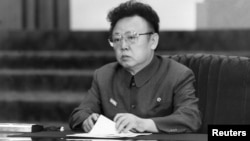
SEOUL — Japanese newspapers are reporting North Korea's late leader gave explicit instructions to mass produce uranium-based weapons. The country contends it is enriching uranium solely for power generation.
The Mainichi Shimbun and Tokyo Shimbun published excerpts from writings purported to expose the North Korean leader's order to mass produce nuclear weapons fueled with highly-enriched uranium.
The Japanese newspapers say the instruction was revealed in a 19-page internal document likely compiled in February of this year for senior officials of North Korea's only political party.
Kim Jong-il died in December of last year and his third son, Kim Jong-un, now runs the reclusive and impoverished country.
In Seoul, Unification Ministry spokesman Kim Hyung-suk was asked by reporters for the South Korean government's reaction to the published reports.
Kim says it is not appropriate for the South Korean government to discuss it as it has no way to immediately confirm the authenticity. He says it is essentially the North Korean government's responsibility to verify the report or say the document is not real.
There has been no immediate reaction from North Korea about the reports.
Professor Ryoo Kihl-jae at the University of North Korean Studies in Seoul says it is not really possible, at this stage, to determine the authenticity of the document.
The professor says, even if the document is verified, it will not change the stance of other countries toward North Korea, because they already know Pyongyang is openly and covertly demonstrating its desire for nuclear weapons.
North Korea has long claimed its uranium-enrichment program is solely for producing electricity. But the Japanese newspapers, citing the document, report the elder Kim clearly told officials to use a uranium-enrichment plant “to mass-produce nuclear bombs.”
Professor Ryoo explains that, although it appears that North Korea's use of plutonium to make nuclear weapons has been halted, the scope of its weapons program remains unknown.
The professor says the purported order to make massive numbers of nuclear weapons is unfeasible for now. But he says North Korea has the capability to increase future production.
North Korea has acknowledged using plutonium, but not uranium, to make nuclear weapons. It carried out two underground detonations in 2006 and 2009, which Pyongyang declared as successful nuclear tests.
There has been speculation among analysts that North Korea might soon attempt a third test, possibly fueled with uranium.
The Mainichi Shimbun and Tokyo Shimbun published excerpts from writings purported to expose the North Korean leader's order to mass produce nuclear weapons fueled with highly-enriched uranium.
The Japanese newspapers say the instruction was revealed in a 19-page internal document likely compiled in February of this year for senior officials of North Korea's only political party.
Kim Jong-il died in December of last year and his third son, Kim Jong-un, now runs the reclusive and impoverished country.
In Seoul, Unification Ministry spokesman Kim Hyung-suk was asked by reporters for the South Korean government's reaction to the published reports.
Kim says it is not appropriate for the South Korean government to discuss it as it has no way to immediately confirm the authenticity. He says it is essentially the North Korean government's responsibility to verify the report or say the document is not real.
There has been no immediate reaction from North Korea about the reports.
Professor Ryoo Kihl-jae at the University of North Korean Studies in Seoul says it is not really possible, at this stage, to determine the authenticity of the document.
The professor says, even if the document is verified, it will not change the stance of other countries toward North Korea, because they already know Pyongyang is openly and covertly demonstrating its desire for nuclear weapons.
North Korea has long claimed its uranium-enrichment program is solely for producing electricity. But the Japanese newspapers, citing the document, report the elder Kim clearly told officials to use a uranium-enrichment plant “to mass-produce nuclear bombs.”
Professor Ryoo explains that, although it appears that North Korea's use of plutonium to make nuclear weapons has been halted, the scope of its weapons program remains unknown.
The professor says the purported order to make massive numbers of nuclear weapons is unfeasible for now. But he says North Korea has the capability to increase future production.
North Korea has acknowledged using plutonium, but not uranium, to make nuclear weapons. It carried out two underground detonations in 2006 and 2009, which Pyongyang declared as successful nuclear tests.
There has been speculation among analysts that North Korea might soon attempt a third test, possibly fueled with uranium.